


Attorney
Specializes in civil and family law. Experience in civil service in the field of DRACS (State Registration of Civil Status Acts) helped to better master the subtleties of civil and family and inheritance law. Also researches the inheritance law systems of continental Europe and the USA (I write scientific articles to enter graduate school)

Certificate of last place of residence of the deceased
When a family starts the process of inheritance, a question often arises: why does the notary need yet another document if there is a death certificate.
The answer is simple: in the inheritance procedure, it is important not only to confirm the fact of death but also to establish where exactly the inheritance is opened.
This determines which notary is handling the case and at which address it should be initiated.
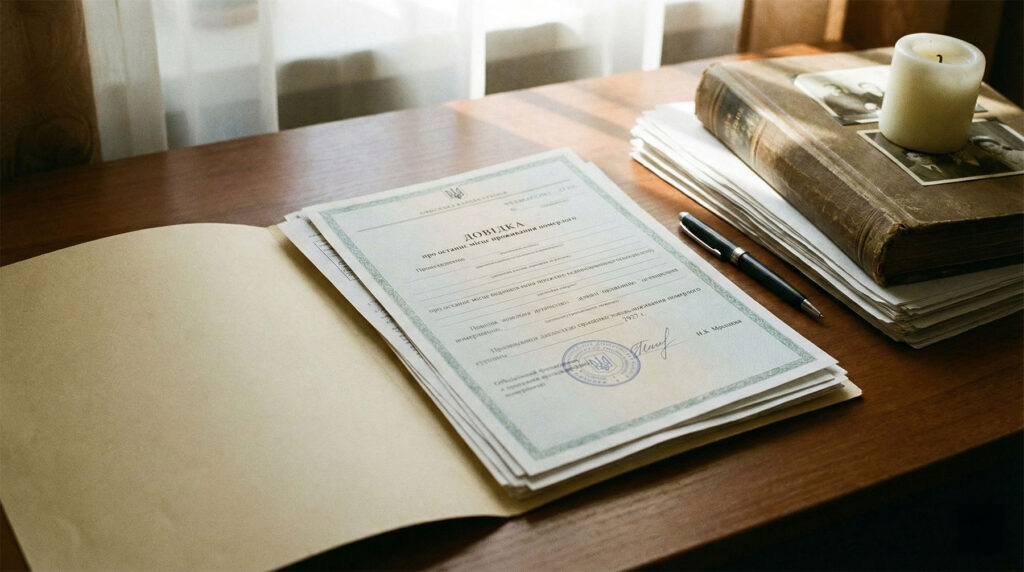
Why is the last place of residence key?
In inheritance matters, the “place of opening the inheritance” is tied to the deceased’s last place of residence.
That is, to the address where the person constantly lived and was registered or declared their place of residence. This may not coincide with where the person actually died.
Death could have occurred in a hospital, during a trip, at relatives’ in another city, or abroad. In such cases, the place of death does not provide the answer to the main question for the notary: where was the person’s “center of life,” and where to open the inheritance case.
Why is the place of death in the death certificate insufficient?
The death certificate records the fact, date, and place where the death occurred. But this document does not confirm the registration or declared place of residence.
Even if the person died at home and the address of death matches the address of residence, for the inheritance case, the notary needs confirmation of the last registration or data from the territorial community’s register. This allows them to act without the risk of error and to correctly form the inheritance case.
Notary and Registers: Who should make the request?
Notaries can receive information from registers, but in real life, situations vary. Sometimes the notary sees the necessary data immediately and opens the inheritance without additional documents.
But it often happens that the information is insufficient, incomplete, or specifically a document is needed that can be attached to the case materials as confirmation.
Then the heir is asked to bring an extract or a certificate to avoid dragging out the process.
When do a certificate or extract become necessary?
There are situations in which confirmation of the last place of residence is almost always required:
- Registration data is old or “transitional” and may not have been included in modern electronic records, or were included with errors.
- The deceased did not live at the registered address, often changed addresses, was deregistered, or the last address is associated with a territory where archives and records are not fully accessible.
In such cases, the document about the last place of residence effectively unties the hands: it provides a clear address for opening the inheritance and reduces the chance that the notary will refuse due to lack of confirmation.
Where to get a certificate or extract?
The document is issued by the body that maintains the residence records in a specific community. Depending on the location, this may be the Center for Administrative Services or the executive body of the local council. They are contacted where the last registration was or where the data about it is stored.
Usually, a death certificate and documents showing your connection to the deceased or the basis to act in their case are required. If a lawyer is applying, documents confirming their authority are submitted.
If the document is not issued or there is no data
It happens that obtaining a certificate is impossible due to the lack of information, inaccessibility of archives, or other circumstances.
Then two approaches are used:
- Focus on the location of the main property (if the last place of residence is not confirmed).
- Apply to the court to establish a legal fact, necessary for the inheritance process.
The choice depends on the evidence available and what exactly the notary needs in your situation.
 The role of a lawyer in this situation
 The role of a lawyer in this situation
In inheritance cases, the question of the last place of residence often becomes a stumbling block for the entire procedure. The lawyer’s task is to resolve this problem at the start and prevent the inheritance process from being delayed.
The lawyer first analyzes the available documents and determines whether they are sufficient to open the inheritance case with this specific notary. If confirmation is insufficient, they immediately choose the correct course of action.
In practice, the lawyer’s role includes:
- determining the body that holds the data about the deceased’s last place of residence, considering reorganizations and archives;
- preparing and submitting applications or lawyer’s requests to obtain a certificate or extract;
- communication with the notary and agreeing on the list of documents that are genuinely needed in the specific case;
- choosing an alternative path if data is missing or its issuance is refused, including focusing on the location of the property or applying to the court;
- forming the evidence base for establishing a legal fact in court.
Such support allows one not to waste time on unnecessary applications and immediately proceed along the path that will be acceptable to the notary and protect the heirs’ interests.
Calculate the cost of services
1 question
The testator died not at his place of permanent residence or registration?
2 question
Does the notary require a certificate or extract of the deceased's last place of residence?
3 question
Is the place of residence missing from the register?
You may also need:
Confirmation of independent maintenance of the child
Read more
APOSTILLE AND LEGALIZATION OF DOCUMENTS IN UKRAINE
Read more
Accompaniment of a lawyer in the children’s service
Read more

Legal assistance in establishing disability
Read more
A court decision on independent upbringing and maintenance of a child as a basis for obtaining a deferment
Read more
Establishing custody of the child
Read more
REGISTRATION OF PERMISSION FOR THE CHILD TO GO ABROAD FROM ONE OF THE PARENTS
Read more
Registration of care on a non-professional basis
Read more
Appeal against the decision of the Medical and social expert commission
Read more
REPRODUCTIVE MEDICINE LAWYER
Read more
Appeal of inheritance contract
Read more
THE TRANSFER OF LAND BY INHERITANCE
Read morecall back
during the day

 Telegram
 Viber
Viber
 WhatsApp

 Facebook
 Instagram