


Head of family law practice
An attorney with extensive experience specializing in complex family disputes. As Head of Practice, he combines deep legal expertise with a personalized approach to every client. He ensures strategic protection of family interests and delivers impeccable results in the most challenging cases.

REGISTRATION OF PERMANENT CARE – 2026
When a loved one cannot independently move around, eat, take medication, or perform household activities due to age, illness, or disability, the family needs to legally record this fact.
This refers to arranging permanent care for individuals who require it: an elderly person, a senior citizen, a person with a disability, or an incapacitated relative.
A legal consultation allows you to determine the grounds, gather the correct document package, and complete the procedure without typical mistakes. The Prikhodko & Partners team explains what issues you can address, what work a specialist will perform, and how to start legal support.
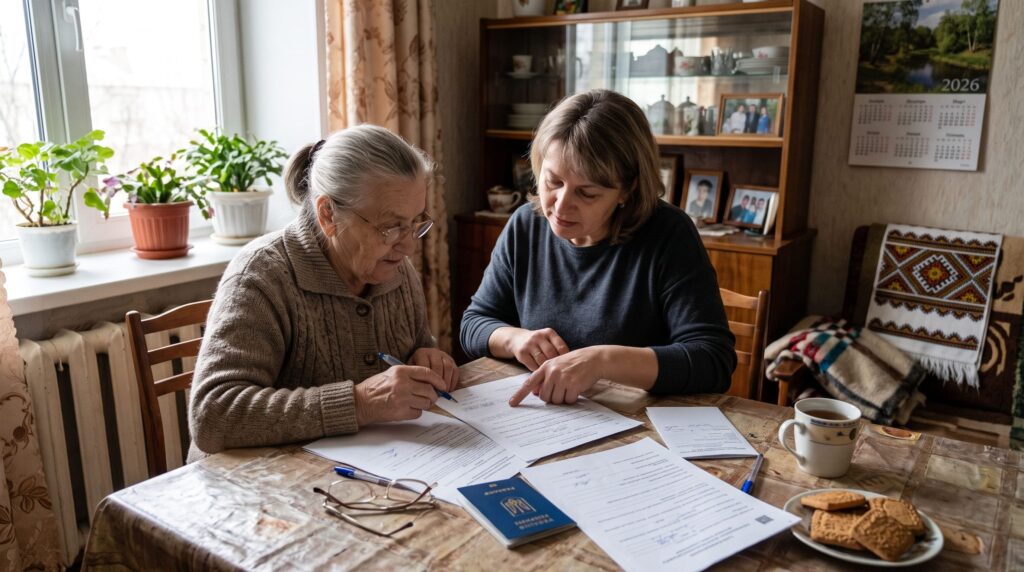
Lawyer services for arranging permanent care
It is worth contacting a specialist if you need to confirm the need for outside assistance, prepare applications, collect medical and personal materials, or handle a refusal from a social protection authority.
Specialists assist with arranging permanent care as a separate procedure: it should not be mixed with care compensation or other social benefits unless there are legal grounds for it.
As part of the service, the team can:
- conduct a consultation and analyze the family situation;
- verify the grounds for arranging care;
- separate the social service, compensation, and other legal regimes;
- evaluate medical reports, certificates, and disability decisions;
- compile a list of documents specifically for your goal;
- prepare applications, explanations, and accompanying requests;
- help collect materials and communicate with institutions;
- represent the client’s interests at a social protection authority, CNAP (Administrative Services Center), or another authorized institution;
- provide a remote consultation if an in-person visit is inconvenient;
- determine actions after receiving a decision.
To get started, sign up for a consultation and provide existing medical and personal documents. After that, the lawyer will outline the scope of legal assistance.
For whom permanent care can be arranged
The question of who can be provided with care does not have a single answer for all families. Permanent outside care is considered for a person who, due to health conditions, is unable to independently care for themselves.
Typical situations:
- an elderly person who has lost the ability to safely move around or cook food;
- a senior citizen with a chronic illness and the need for daily assistance;
- a person with a disability, if medical documents confirm the need for permanent care;
- an incapacitated person whose interests are represented by a guardian;
- a relative who needs permanent care due to a severe health condition.
Old age or a disability group in themselves do not automatically guarantee a positive decision. The authority evaluates medical confirmations, family relationships, place of residence, actual provision of care, and the purpose of the application.
If care for an incapacitated person is planned, documents regarding guardianship and the scope of the representative’s powers are additionally verified.
A specialist does not promise a result on behalf of the authority. They demonstrate whether there is a chance to confirm the need and what package should be prepared. The next step is a consultation with an analysis of existing certificates, rather than submitting an incomplete set “to try out.”
Advantages of working with Prikhodko & Partners
Arranging care for an elderly person often fails due to an outdated medical report, an incomplete document package, or applying to the wrong institution. The team works with family and social matters, so they evaluate the entire structure of the case rather than an individual certificate.
The client receives:
- review of documents before submitting the application, not after a refusal;
- an individual strategy: what to apply for now and what not to mix in one request;
- preparation of applications in language accepted by a specific institution;
- legal support for relatives, guardians, and individuals actually providing assistance;
- clear explanations without unnecessary theory;
- the possibility of a remote consultation;
- a transparent scope of work prior to signing the agreement.
This format reduces the risk of rejection due to formal errors and gives the family a controlled plan of action.
How to arrange care for an elderly person in 2026
Below is the working logic followed by lawyers when handling a case. This is not a universal instruction for all communities: requirements of the social protection authority may vary.
- Initial consultation. We clarify for whom assistance is planned, the diagnosis and degree of independence, who actually provides care, where the ward resides, and why formal arrangement is needed: for social services, compensation, or confirmation of the fact of care.
- Verification of grounds. We assess whether medical documents confirm the need for permanent outside care, whether an LKK (Medical Advisory Commission) report is sufficient, or if additional examinations are required.
- Forming the document package. We prepare applications and attachments tailored to a specific authority, rather than a “maximum set just in case.”
- Submission. We accompany the application to the social protection authority, through CNAP, or via another channel provided in your community.
- Monitoring the review process. We track requests from the authority, prepare responses to them, and record deadlines.
- Actions after the decision. If a refusal is received, we analyze its motives: whether to finalize the package, resubmit, or appeal.
How to arrange care for an elderly person without unnecessary delays is not a matter of general knowledge of the law, but of choosing the right procedure. Book a consultation to receive a step-by-step plan based specifically on your documents.
Documents for arranging permanent care
The list is not identical for everyone. Documents for elder care depend on who is being registered, whether there is a disability, whether incapacity has been established, and whether you are requesting compensation.
The following may typically be required:
- passport and RNTRC (Tax ID) of the applicant;
- documents of the person requiring assistance;
- LKK medical report or another certificate confirming the need for care;
- disability documents — if available;
- proof of family relationship;
- application from the person who will provide care;
- consent of the ward, if they are able to provide it;
- documents regarding place of residence and shared household, if required by the procedure;
- court decision on legal incapacity and guardian documents;
- income materials if care compensation is being considered.
Do not collect everything indiscriminately: extra papers will not replace a missing medical confirmation, while an incomplete set halts the review. A lawyer checks the authority’s requirements against your available materials and tells you what is missing. After that, you can order application preparation and submission support.
Stages of cooperation with an attorney
- You get in touch with a brief description of the situation.
- We conduct an initial consultation: what is already available, what is missing, and what result is needed.
- We agree on the contract goals — consultation, document preparation, or full legal support.
- We draft applications, explanations, and list of attachments.
- We coordinate terms, deadlines, and format of work, including online.
- We sign the agreement and provide legal support for the agreed scope of work.
This way, the family clearly sees what the lawyer is responsible for and where their participation is needed: obtaining a medical report, signing an application, or appearing at the authority.

Cost of attorney services for arranging permanent care
The fee is not fixed “per certificate,” as the scope of work varies. The price is influenced by the complexity of circumstances, number of documents, need to prepare several requests, consultation format, and whether representation before authorities is required. Appealing a refusal is evaluated separately.
Before starting, the client receives an explanation: what is included in the service, which actions are paid for, and which depend on the authority’s response.
| Factor | How it affects the cost |
| Case complexity | Checking multiple legal aspects requires deeper analysis. |
| Volume of documents | Medical, guardianship, and other materials increase the lawyer’s working time. |
| Preparation of applications | The number of requests and necessary revisions affects the workload. |
| Format of assistance | The cost depends on whether a one-time consultation, remote assistance, or full legal support is required. |
| Representation of interests | Communication with state institutions is a separate line of work. |
| Appealing a refusal | Preparation of a resubmission or complaint is carried out after analyzing the written decision. |
Arranging permanent care for an elderly person or another relative who cannot care for themselves should begin with checking the grounds and documents, rather than submitting an application at random.
Lawyers at Prikhodko & Partners will help determine the procedure, prepare requests, and accompany the review. Leave a request for a consultation to receive an action plan tailored to your situation.
Calculate the cost of services
1 question
Are you in Kyiv or Kyiv region?
2 question
Have you already contacted the guardianship and guardianship authorities on your issue?
3 question
Do you need legal help urgently?
How to arrange care for an elderly person?
It is necessary to confirm that the person requires permanent outside assistance, collect medical and personal documents, prepare an application, and submit it to the social protection authority or via CNAP. The exact path depends on the goal of the application and community requirements.
For whom can permanent care be arranged?
Usually, this applies to an elderly person, a person with a disability, an incapacitated relative, or a close person who cannot independently care for themselves due to health conditions. The final assessment is based on documents, not just age or diagnosis.
Which documents are requested most often?
Passports, tax IDs, an LKK medical report or other certificate confirming the need for care, proof of family relationship, caregiver’s application, documents regarding guardianship, place of residence, and income. The final list is compiled by the authority for the specific procedure.
Is disability status sufficient to arrange assistance?
No. It is necessary to show that the person requires specifically permanent outside care. Disability documents can be part of the package, but they do not replace medical confirmation of the need for care.
What should be done if a relative is declared legally incapacitated?
Additionally, court decisions, guardian documents, and the scope of their powers are taken into account. The application and attachments are prepared by the representative, not the ward.





You may also need:
REGISTRATION OF PERMISSION FOR THE CHILD TO GO ABROAD FROM ONE OF THE PARENTS
Read more
Establishment of guardianship over an incapacitated person
Read more
THE TRANSFER OF LAND BY INHERITANCE
Read more
Registration of care on a non-professional basis
Read more
Provision of care for children with disabilities in Ukraine
Read more
Establishing custody of the child
Read more
APOSTILLE AND LEGALIZATION OF DOCUMENTS IN UKRAINE
Read more
Appeal against the decision of the Medical and social expert commission
Read more
APOSTILLE ON THE DECISION OF THE COURT
Read more
Registration of a child born through reproductive medicine
Read more
Appeal of inheritance contract
Read more
Confirmation of independent maintenance of the child
Read morecall back
during the day

 Telegram
 Viber
Viber
 WhatsApp


 Facebook
 Instagram