


Lawyer
Specializing in migration law - processing documents on the territory of Ukraine, European Union countries (Poland, Italy, Spain, Hungary, Romania), providing visa assistance for Ukrainian citizens and foreigners.

Search for relatives in the archives
Today, thousands of Ukrainians are considering options for legalization abroad, obtaining permanent residence permits (PR), or getting a second European-style passport.
One of the most effective, legal, and reliable ways is participation in state repatriation programs. However, the basic condition of such programs is undeniable documentary confirmation of your ethnic origin. Given the turbulent history of Ukraine, migrations, border changes, and wars, a significant part of family documents has been lost.
That is why searching for relatives in archives becomes the first and most important step for those planning immigration. This is a profound legal and genealogical procedure that allows you to find ancestors for citizenship, restore lost metric records, and officially prove blood relation to representatives of another nationality.
Professional archival document search guarantees that your papers will be accepted by consulates and migration services of foreign states without unnecessary delays.
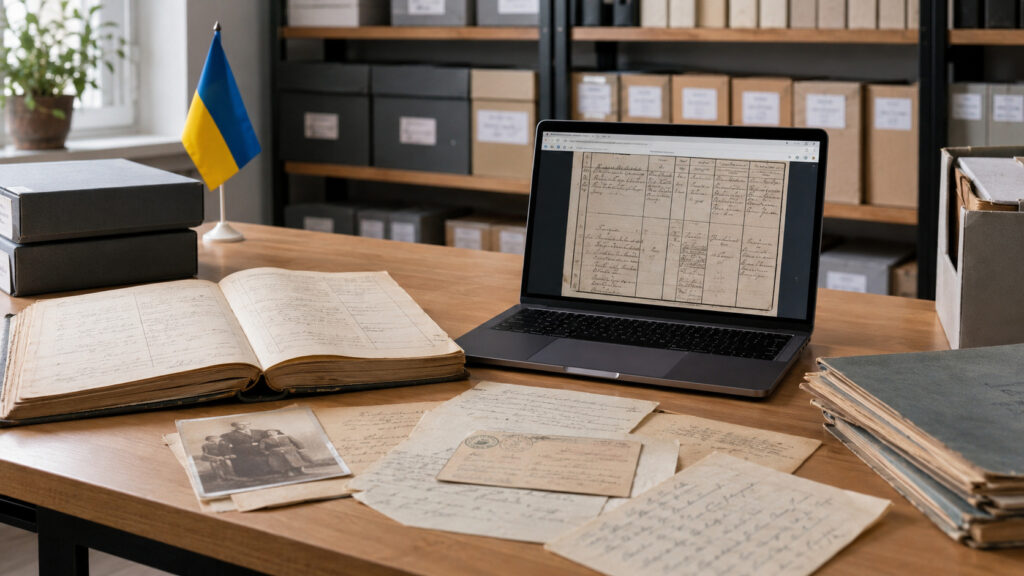
What is an archival document search and why is it needed?
In the legal practice of migration law, this term refers to a complex of measures aimed at identifying, retrieving, and properly formalizing official information regarding the birth, marriage, name change, or death of your ancestors.
Targeted search differs from the usual creation of a family tree. If genealogy is interested in the history of the family in general, legal assistance in searching for roots is aimed exclusively at obtaining documents that have legal force for consulates.
This includes excerpts from state registers, archival certificates, copies of civil status records, confession lists, or metric books.
If you decide to order an archival search (Kyiv or another city in Ukraine), you receive not just information about where your grandparents or great-grandparents lived, but a legalized document that is the basis for obtaining citizenship.
Who can receive documents and contact the archive?
According to the Law of Ukraine “On the National Archival Fund and Archival Institutions” and the norms of the Law of Ukraine “On Personal Data Protection,” access to information containing third-party personal data is restricted.
Accordingly, the procedure can be initiated by:
- Directly lineal descendants of the person regarding whom the request is made (children, grandchildren, great-grandchildren).
- Legal representatives of the descendants (for example, parents acting in the interests of minor children).
- Qualified lawyers acting on the basis of a warrant or a notarized power of attorney from the client.
It is important to understand that for the archive or Civil Status Registration Offices (DRACS) to provide information, the applicant must document the entire chain of kinship.
That is, to obtain an excerpt about the birth of your great-grandmother, you need to provide your own birth certificate, your parents’ birth and marriage certificates, as well as your grandmother’s or grandfather’s certificate.
For which countries do Ukrainians most often search for roots?
Commercial requests for document restoration are most often related to the migration policies of several popular jurisdictions:
- Poland. It is necessary to find documents for the Karta Polaka archive or papers for the procedure of recognition as a citizen. Records are sought regarding the Polish nationality of parents, grandparents, or both great-grandparents, or proof of their participation in elections to the Sejm or service in the Polish Army.
- Romania. The simplified program for restoration of citizenship requires proof of birth or residence of your direct relatives (up to the third degree of kinship) in the territories of Bessarabia or Northern Bukovina during the period from 1918 to 1940.
- Bulgaria. Finding ancestors for citizenship of this country means obtaining an archival certificate where “Bulgarian” is clearly indicated in the “nationality” column for your relatives.
- Germany and Israel. Proving German origin (late resettlers program) or Jewish roots (Law of Return) through the retrieval of excerpts from Soviet-era civil status records, extracts from household registers, or records of the repressed.
Procedure: main stages of document search in archival institutions
Each case is unique, but the standardized legal procedure is as follows:
Stage 1. Initial consultation and audit of available data
The lawyer conducts a detailed analysis of the information already held by the client.
Basic data required from you: full name of the ancestor, approximate years of life, place of birth or residence, religion. At this stage, a strategy is formed and the preliminary price of services is determined.
Stage 2. Determining jurisdiction and funds
Documents up to 75 years old are stored in the Civil Status Registration Offices (DRACS). If the records are older than 75 years, they are transferred to the regional or central state historical archives of Ukraine.
Additionally, information may be checked in the archives of the SBU (Security Service of Ukraine) or the Ministry of Internal Affairs (if relatives were repressed or deported).
Stage 3. Submitting lawyer’s requests
This is the most important stage. Independent inquiries by citizens are often processed for months or result in formal replies. A professional search for relatives through a lawyer involves submitting an official lawyer’s request.
According to the law, state institutions are obliged to provide a response to a lawyer within 5 working days (with a possible extension up to 20 days if the request requires a deep analysis of a large volume of data).
Stage 4. Judicial establishment of facts (if necessary)
It often happens that metric books were destroyed during World War II. If the archive issues an official certificate of non-preservation of funds, the lawyer initiates a court process.
Based on indirect evidence (military ID cards, party membership cards, employment records), the court can establish the fact of kinship or the person’s belonging to a certain nationality.
Stage 5. Legalization of documents
Obtaining the papers is only half the battle. For a foreign consulate to accept them, the documents must undergo a legalization procedure.
Usually, this involves affixing the Apostille stamp (Apostille) at the Ministry of Justice of Ukraine and subsequent notarized or sworn translation into the language of the target country.
Target areas of legal archival search
| Country of Migration | Goal of Ancestor Search | Required Documents |
| Poland | Karta Polaka, citizenship | Extracts confirming Polish nationality, records of service or elections |
| Romania | Restoration of citizenship | Proof of birth in the territory of Greater Romania (until 1940) |
| Bulgaria | Citizenship by origin | Civil status record indicating the ancestor’s Bulgarian nationality |
| Germany | Late Resettlers Program | Evidence of German nationality, repression, or resettlement |
How a lawyer can help: advantages of a professional approach
The bureaucratic system of archives and Civil Status Registration Offices (RACS) is complex and unforgiving of errors. The usual restoration of an ancestor’s birth certificate can turn into a real ordeal if you do not know the current legal requirements.
Engaging a migration lawyer provides you with the following advantages:
- Efficiency: lawyer’s requests are processed outside the general queue, which significantly saves your time.
- Accuracy of wording: the lawyer demands not just the issuance of a certificate, but the formation of a full extract from the register with all changes made and an indication of nationality (which is critical for foreign agencies).
- No borders: you can be abroad; the entire procedure is carried out remotely based on a power of attorney.
- Overcoming bureaucratic obstacles: in case of errors in civil status records (discrepancies in the letters of the surname or dates), the lawyer ensures that the relevant changes are made to the registers through the court or the leadership of the justice department.
- “Turnkey” complexity: you receive a ready, translated, and apostilled package of documents that can be immediately submitted to the consulate.
Lack of documents — this is not a sentence for your migration plans, but just a legal task that requires a professional solution. Our team of migration law experts is ready to take on the entire bureaucratic burden.
If you are interested in a professional archival document search, establishing family ties, and forming a dossier for obtaining EU citizenship — contact us for a consultation.
We will analyze your situation, assess the prospects, and find the lost roots quickly and in compliance with all legal norms. Order a legal analysis of your pedigree today to open the borders of European states for yourself and your family!
Calculate the cost of services
1 question
Do you want to find your relatives?
2 question
Do you want to find relatives for citizenship?
3 question
Are you currently in Ukraine?
How long does an archival document search take to confirm nationality?
The terms depend on the initial data and the institution where the documents are stored. If the necessary records are in the DRACS archives and preserved in the electronic register, the procedure takes from 1 to 3 weeks based on a lawyer’s request.
If the matter concerns regional historical archives, where the search is conducted manually in paper metric books from the late 19th – early 20th centuries, the process can last from 1 to 3 months.
What to do if the archive provided an official response that the documents were destroyed during the war?
In such cases, it is necessary to collect certificates of non-preservation of funds (they are official proof that you have exhausted the pre-trial method of solving the problem) and apply to the court with a statement to establish a fact of legal significance (for example, the fact of kinship or the fact of the parents’ nationality).
The court will make a decision based on other evidence: autobiographies, household registers, military ID cards, etc.
Can I order an archival search for ancestors if I am currently abroad?
Yes, the absolute majority of such cases are conducted remotely. For this, you need to issue a notarized power of attorney for our lawyer at the Consulate of Ukraine abroad or with a local foreign notary (followed by affixing the Apostille).
After this, the lawyer will represent your interests in all archives and state institutions on the territory of Ukraine.


You may also need:

A statement of claim for the issuance of a passport in the form of a booklet
Read more
Citizenship of Malta for investment
Read more
USA Family Reunion Visa
Read more
Electronic queue for foreign passports
Read more
Obtaining Romanian citizenship
Read more
Getting a residence permit in the UAE when buying real estate
Read more

GET PORTUGAL CITIZENSHIP
Read more
Registration of Homes for Ukraine
Read more
Immigration to the USA
Read more
GET A PERMANENT RESIDENCE PERMIT IN HUNGARY
Read more
Residence permit for family reunification: Spain
Read more
Get a permanent residence permit in Spain
Read morecall back
during the day

 Telegram
 Viber
Viber
 WhatsApp


 Facebook
 Instagram