


Lawyer
Specializing in migration law - processing documents on the territory of Ukraine, European Union countries (Poland, Italy, Spain, Hungary, Romania), providing visa assistance for Ukrainian citizens and foreigners.

Family reunification visa in Germany
The desire to live with one’s loved ones is a fundamental right enshrined in both international and German law. If your husband, wife, parents, or children legally reside in the Federal Republic of Germany (FRG), you have legal grounds to join them.
For this purpose, a family reunification visa to Germany is processed. This process is one of the most complex in migration law, as it requires a deep understanding of current laws, proper preparation of documents, and passing strict checks at the embassy.
As an expert in migration law, I help Ukrainians successfully navigate all stages of this procedure.
In this article, we will examine in detail how to obtain a family reunification visa to Germany, what documents will be needed, and how to avoid typical mistakes that lead to rejections.
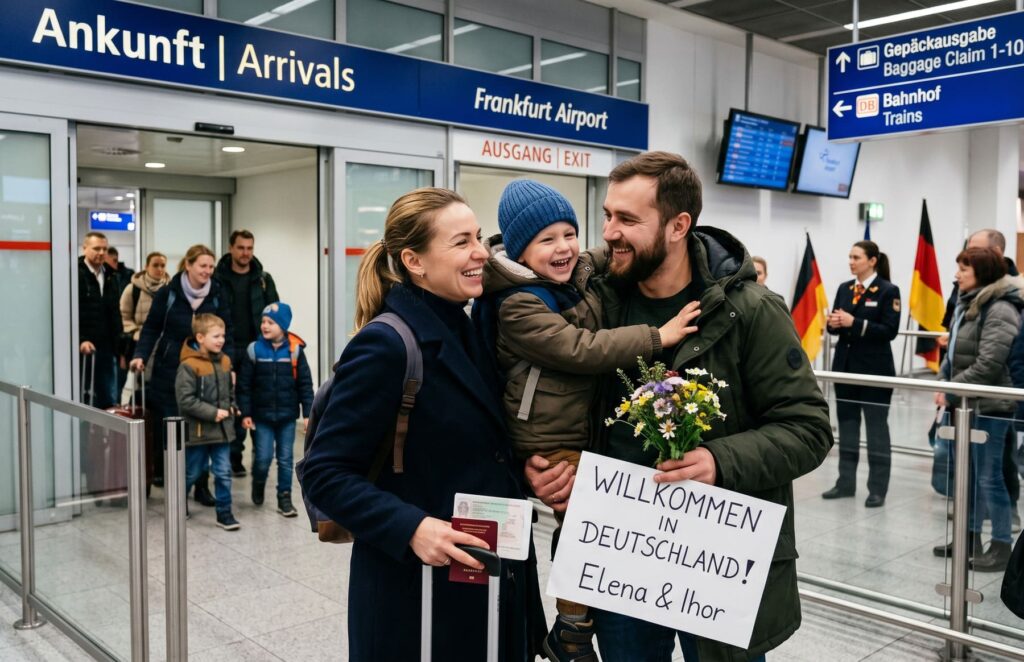
What is the National Visa D for family reunification and who is it issued to?
National Visa D (Germany) is a long-term visa that grants the right to enter the country for the purpose of subsequently obtaining a residence permit (Aufenthaltstitel).
Unlike the standard visa-free regime or a Schengen visa, the national visa allows you to legally stay in the country for more than 90 days, and subsequently—to work and integrate into society.
The following categories of persons are entitled to apply for a visa to Germany for Ukrainians under the reunification program:
- Spouses (husband or wife), provided the marriage is officially registered and recognized under German law.
- Minor children (under 18 years old) who are not married and wish to move to one or both parents.
- Parents of minor children, if the child already has German citizenship and permanently resides in the country.
- In exceptional cases (the so-called “special hardship” or Härtefall)—other family members, such as adult children or elderly parents who require constant care.
Main requirements for applicants and the host party
To obtain a family reunification visa in Germany, the migration office (Ausländerbehörde) and the embassy impose strict requirements. Their fulfillment is mandatory for the approval of your application.
- Financial security (Sicherung des Lebensunterhalts). The host party (the one already living in the FRG) must prove the ability to support their family without recourse to state social assistance (Bürgergeld). For this, employment contracts, salary statements (Lohnabrechnungen) for the last 3–6 months, or tax declarations for entrepreneurs are provided.
- Sufficient living space (Wohnraum). The law requires the availability of rented or owned housing. On average, the norm is 12 square meters per adult family member and 10 square meters per child under the age of 6. A rental agreement (Mietvertrag) must be provided.
- Knowledge of the German language (Sprachkenntnisse). For reunification with a husband/wife, Germany requires the applicant to have a basic language proficiency at level A1 (confirmed by a certificate from Goethe-Institut, TestDaF, ÖSD, or TELC). However, there are exceptions: language is not required if your partner holds the EU Blue Card (Blaue Karte EU), is a highly qualified specialist, or if it concerns the reunification of parents with a German child.
- Age qualification for spouses. Both spouses must be 18 years old at the time of document submission. This rule is in place to prevent sham and forced marriages.
What documents are needed for a visa to Germany?
The package of documents may vary depending on your individual situation, but the basic list for obtaining a family reunification visa in Germany includes:
- A completed visa application form in German, in two copies.
- Three current biometric passport-sized photographs.
- The applicant’s foreign passport (original and copies of all pages with marks).
- Internal passport of a citizen of Ukraine (or ID card with a residence registration extract).
- Marriage certificate (for spouses) or birth certificate (for children). Important: Ukrainian certificates must have an Apostille stamp (Apostille) and be translated by a sworn translator in Germany (vereidigter Übersetzer).
- Copy of the passport and residence permit of the host party.
- Documents confirming income and the availability of housing in the FRG.
- Medical insurance for the first weeks of stay.
- Certificate of German language proficiency at A1 level (if required by law).
Please note that incorrect translation or the absence of even a single document can delay the visa processing for Ukrainians by several months or lead to an official rejection.
Summary Table: Applicant Categories and Procedural Features
For better understanding and SEO-structuring of information, we suggest reviewing the requirements for various applicant categories planning to obtain a visa to Germany:
| Target Applicant Category | German Language Proficiency Requirements | Key Features of the Application Process |
| Reunification with Husband / Wife | Mandatory A1 level certificate | Marriage must be concluded before application. Apostille of the marriage certificate is required. |
| Reunification with an EU Blue Card Holder | Language proficiency is not legally required | Simplified income verification procedure, accelerated application review. |
| Relocation of a Minor Child to Parents | Language is not required (up to 16 years old) | Notarized consent from the second parent is required (if they remain in Ukraine). |
| Relocation of Parents to a German Citizen Child | Language proficiency is not required at the start | The child must permanently reside in Germany. Reviewed the fastest. |
Application Stages and Cost of a Visa to Germany
The procedure for obtaining a National Visa type D consists of several key steps. First, you gather all the necessary documents and order their sworn translation.
Next, you need to book an interview at the German Embassy or a visa application center (Visametric). When submitting, you pay the consular fee.
The cost of a visa to Germany (consular fee) is 75 euros for adults and 37.50 euros for minor children.
However, if you are applying for a visa for reunification with a German citizen or an EU citizen, the visa fee is usually not charged. The document processing time is from 4 to 12 weeks.
This is because the embassy forwards your documents to the foreigners’ authority (Ausländerbehörde) at the place of your future residence in Germany.

Why should you order the services of a migration lawyer?
Independent application for a visa to Germany for Ukrainians is often accompanied by stress, bureaucratic red tape, and the risk of rejection due to minor legal errors in filling out the forms.
A Migration Lawyer will help you save time and nerves. We provide:
- Detailed audit of your situation and assessment of the chances for successful family reunification.
- Preparation and legalization of the full package of documents (including Apostille).
- Filling out visa applications in accordance with the requirements of German law.
- Communication with the Ausländerbehörde on your behalf.
Do not risk your family’s future. Make the relocation process legal, safe, and fast. Submit an application for a consultation with a migration lawyer right now, and we will start the process of preparing documents for your family reunification visa to Germany today!
Calculate the cost of services
1 question
Do you have relatives in Germany?
2 question
Are you currently in the EU?
3 question
Do you have proof of family ties with German citizens?
4 question
Do you know German?
Can I apply for family reunification if I am in Germany on biometric stay?
According to the general rule, the submission of documents for a National Visa D must be carried out exclusively in the country of your permanent residence (at the German Embassy in Ukraine or in authorized representations abroad, if you have a residence permit there).
It is usually not possible to submit an application while in Germany in tourist status (on biometrics), except in rare exceptional cases.
What should I do if the migration service refused to issue a reunification visa?
If you receive a refusal, you have the right to file an appeal (Remonstration) with the embassy or the opportunity to appeal the decision through the administrative court in Berlin within one month.
In such a situation, it is critically important to immediately involve a specialized migration lawyer to analyze the reasons for the refusal and draw up a competent appeal complaint.
Do I have the right to work in Germany after family reunification?
Yes, if your husband or wife has a residence permit that allows them to work (for example, the EU Blue Card or permanent residence permit), you will also receive a work permit (Erwerbstätigkeit gestattet) immediately after you are issued the corresponding residence permit based on family reunification.



You may also need:

A statement of claim for the issuance of a passport in the form of a booklet
Read more
Get EU citizenship
Read more
Electronic queue for foreign passports
Read more
Israeli citizenship
Read more
B1/B2 visa to the USA
Read more

Get a permanent residence permit in Poland
Read more
Residence permit for family reunification: Spain
Read more
GET A PERMANENT RESIDENCE PERMIT IN HUNGARY
Read more
Citizenship of Malta for investment
Read more
U4u for Ukrainians
Read more
GET A TEMPORARY RESIDENCE PERMIT IN SPAIN
Read more
Cyprus: digital nomad visa
Read morecall back
during the day

 Telegram
 Viber
Viber
 WhatsApp

 Facebook
 Instagram