



Head of real estate and commercial law practice
Specialist in the field of commercial law and process. Real estate, construction support; land law and protection of property ownership.
Case: Protected the client’s property rights in a case involving the prosecutor’s office’s appeal of the privatization of a land plot

Service: Lawyer for land privatization
For most landowners, obtaining an extract from the State Register of Property Rights means the completion of the property registration process. However, practice shows that even years after the registration of ownership rights, the state may question the legality of acquiring a land plot.
This issue is especially relevant for investors, property owners, and entrepreneurs who use land as an asset for business development, construction, or attracting financing. That is why the legality of procedures related to land privatization remains relevant even after all registration procedures have been completed.
In this article, we will review a real case from practice where the prosecutor’s office attempted through court proceedings to revoke ownership rights to a land plot, and we will also analyze the risks that asset owners should take into account.
Why the prosecutor’s office challenges land privatization
In recent years, the prosecutor’s office has actively used the mechanism of representing the interests of the state to review decisions made many years ago. Most often, the subject of disputes concerns land plots transferred to citizens through free privatization procedures.
Typical arguments used in such cases include:
- repeated use of the right to free privatization;
- errors in documents or cadastral records;
- violations of the land transfer procedure;
- non-compliance with the designated purpose of the land plot;
- exceeding authority by the body that adopted the decision.
At the same time, the mere filing of a lawsuit does not automatically mean that violations actually occurred. Quite often, state authorities build their position on an incomplete analysis of documents or incorrect interpretation of land legislation.
Such risks may arise not only with regard to land plots. Practice shows that questions regarding the legality of property transfer often also arise when reviewing procedures related to privatization of real estate objects, especially when it concerns assets acquired many years ago.

What risks arise for asset owners
For businesses, a land dispute is rarely limited to court proceedings alone.
Challenging ownership rights may lead to:
- blocking investment projects;
- complications in selling or transferring the asset;
- banks refusing financing;
- loss of the investment attractiveness of the property;
- additional expenses for legal defense;
- delays in implementing business plans.
Particularly dangerous are situations where the land plot is used for development, is the subject of an investment agreement, or serves as collateral for loan obligations.
That is why verification of the history of ownership acquisition should be an integral part of legal risk management.
Case study: the prosecutor’s office demanded the return of land to the state
Our team was approached by a Client after receiving a lawsuit from the prosecutor’s office.
The prosecutor’s office requested the court to:
- declare the order on land privatization unlawful;
- cancel the state registration of ownership rights;
- return the land plot to the state.
Position of the prosecutor’s office
According to the claimant, the Client allegedly violated the requirements of the Land Code of Ukraine and repeatedly exercised the right to free privatization of a land plot with the same designated purpose.
In fact, the prosecutor’s office argued that the person exercised the same right twice, which constituted grounds for revoking the privatization results.
Situation analysis and formation of the legal position
After receiving the case materials, a detailed analysis of all documents that served as the basis for the emergence of ownership rights was conducted.
During the preparation of the legal position, special attention was paid to:
- analyzing the history of acquisition of rights to the land plots;
- verifying the designated purpose of each land plot;
- studying the current practice of the Supreme Court regarding repeated privatization;
- identifying procedural deficiencies in the claimant’s position.
The key point was proving that the land plots referred to by the prosecutor’s office were not identical in terms of their designated purpose.
This circumstance significantly affected the correct application of land legislation and refuted the claimant’s main argument.
Result
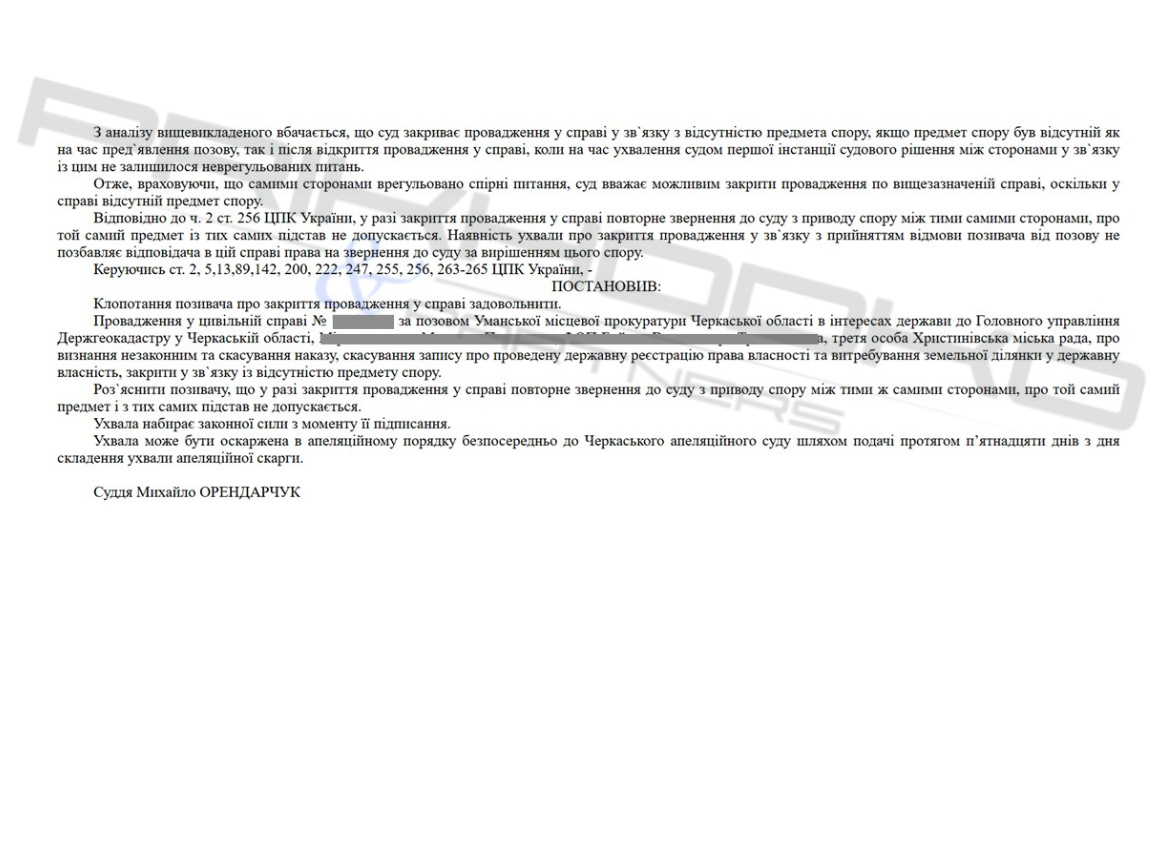
After reviewing the prepared objections, evidence, and legal position, the prosecutor filed a motion with the court to close the proceedings due to the absence of the subject matter of the dispute.
In fact, the case was resolved at the preparatory stage without proceeding to a full trial on the merits.
For the Client, this meant:
- preservation of ownership rights to the land plot;
- absence of the risk of losing the asset;
- minimization of time and financial expenses;
- no need to undergo years of litigation.
Photo confirmation of the work result
What conclusions property owners and investors can draw
Practice shows that most such disputes arise not because of the current use of the land plot, but because of events that took place during its registration many years ago.
That is why it is advisable to periodically check:
- Documents that served as the basis for acquiring ownership rights.
- Compliance of the designated purpose of the land plot.
- Data from the State Land Cadastre.
- Possible risks of challenging privatization procedures.
- Court practice regarding similar categories of disputes.
It should be taken into account that disputes regarding land plots often arise precisely after the completion of land privatization procedures, when owners consider the issue of registration of rights to be finally resolved.
In complex situations, a comprehensive legal audit conducted by a real estate lawyer specializing in land and property disputes helps assess potential risks and identify weaknesses in the documentation.
Challenging privatization results remains one of the most common tools for reviewing rights to land assets. At the same time, the mere filing of a lawsuit does not automatically mean loss of property.
Proper document analysis, correct application of current court practice, and a timely formed legal position allow effective protection of ownership rights even in disputes with state authorities.
The reviewed case demonstrates that high-quality preparation already at the preparatory proceedings stage can lead to the resolution of the dispute without years o





















 Telegram
 Viber
Viber
 WhatsApp

 Facebook
 Instagram