



Senior lawyer
Lawyer in the field of military law. Specializes in issues of mobilization, postponement and reservation. Provides services for appeals to the military medical commission, escorting to the military commissariat, dismissal from military service, obtaining the status of a participant in hostilities. Conducts court cases on military issues.
Case: We overturned the Ministry of Defense’s refusal to grant assistance to a deceased serviceman’s family based on the presence of alcohol in his blood

The wife of a deceased serviceman contacted Prikhodko & Partners Law Firm after Ukraine’s Ministry of Defense refused to grant her a one-time financial benefit in connection with her husband’s death.
The refusal was based on alcohol found in the serviceman’s blood during a forensic medical examination. On this basis, the authorized commission of the Ministry of Defense concluded that state assistance could not be granted to his family.
However, the medical documents confirmed that the man’s death had resulted from a disease connected with his military service.
The main objective for the lawyers at Prikhodko & Partners was to demonstrate that the refusal was unfounded, challenge the Ministry of Defense’s decision, and restore the possibility of obtaining the financial assistance provided for by law for the deceased serviceman’s wife and children.
What made the situation complex?
Following the serviceman’s death, his wife submitted documents to the authorized bodies to apply for a one-time financial benefit.
However, when reviewing the documents, the Ministry of Defense refused to grant the payment to the family, citing the results of a forensic toxicology examination that detected ethyl alcohol in the deceased man’s blood.
There was, however, a fundamental legal distinction in this situation.
The mere presence of alcohol in a serviceman’s blood does not automatically deprive his family of the right to a one-time financial benefit. For the relevant restriction to apply, a causal link must be established between the person’s actions while intoxicated and their death.
The client’s documents, by contrast, stated that her husband’s death was caused by an acute impairment of blood circulation in the myocardium. The Military Medical Commission (MMC) had also established a connection between the disease that caused his death and his military service.
This contradiction between the medical findings and the Ministry of Defense’s decision became central to the subsequent court challenge.
Legal support from Prikhodko & Partners Law Firm
Senior lawyer for military matters Danylo Honcharenko began working on the case by analyzing the documents on which the Ministry of Defense had based its refusal to grant the family a one-time financial benefit.
He examined the medical documents concerning the serviceman’s cause of death, the MMC finding on the connection between the disease and military service, the forensic medical examination results, and the decision of the Ministry of Defense commission.
The key legal argument was that the Ministry of Defense had failed to prove that the serviceman’s death resulted specifically from his actions while intoxicated.
Based on the materials collected, an administrative claim was prepared to challenge the refusal to grant financial assistance.
In court, the lawyers sought:
- A declaration that the Ministry of Defense commission’s decision refusing to grant a one-time financial benefit was unlawful, and its annulment.
- Consideration of the medical findings confirming the serviceman’s actual cause of death.
- Restoration of the family’s rights by requiring the Ministry of Defense to reconsider the documents concerning the benefit.
During the court proceedings, we substantiated that the law requires a direct connection between actions committed while intoxicated and the serviceman’s death.
This position was also consistent with Supreme Court case law, under which the mere presence of alcohol in the blood is insufficient grounds to refuse assistance to family members.
The court found that the Ministry of Defense had not provided proper evidence that the serviceman had committed actions while intoxicated that directly caused his death.
As a result, the court declared the Ministry of Defense’s refusal unlawful and annulled the relevant commission decision.
The court also ordered the Ministry of Defense to reconsider the deceased serviceman’s wife’s application for a one-time financial benefit, taking into account the circumstances and legal conclusions established by the court.
Outcome
Prikhodko & Partners Law Firm secured the annulment of the Ministry of Defense’s unlawful refusal to grant a one-time financial benefit to the deceased serviceman’s family.
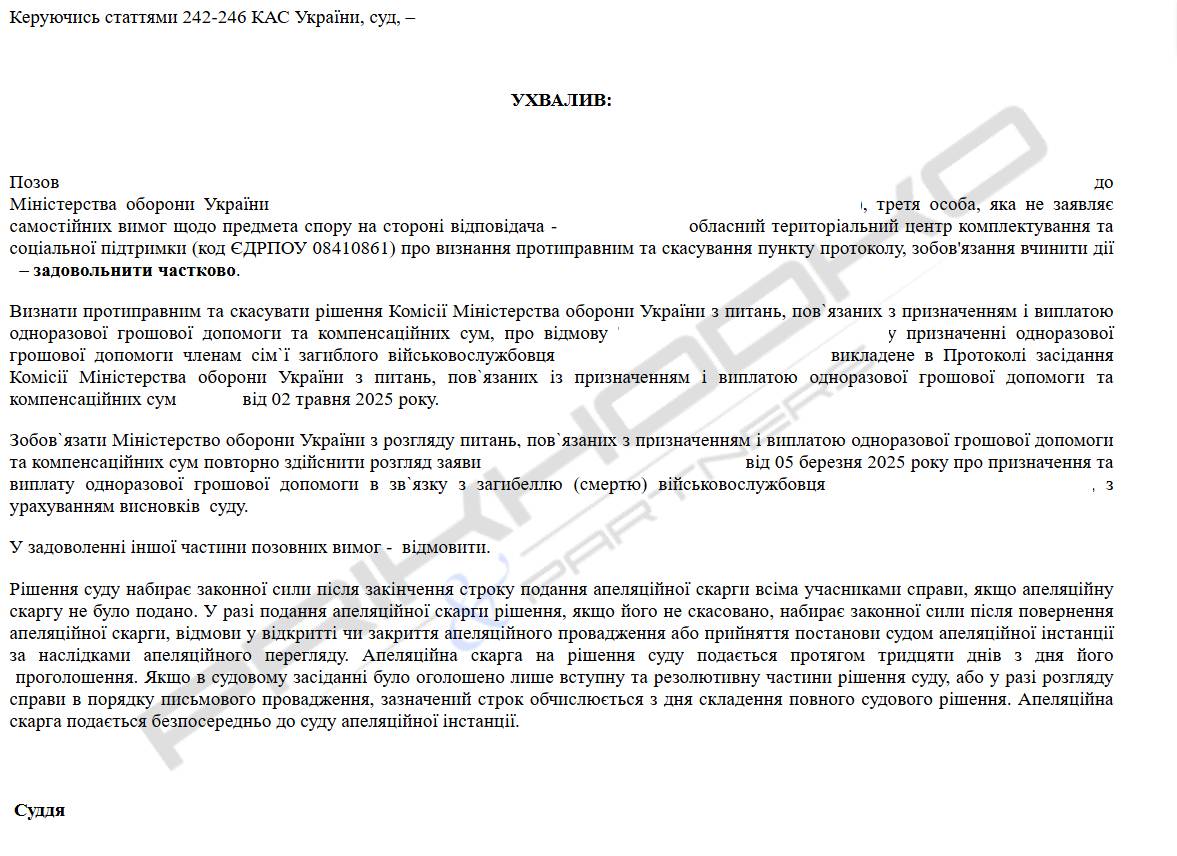
The legal support made it possible to refute the grounds for the refusal and require the Ministry of Defense to reconsider the question of granting assistance to the deceased serviceman’s wife and children.
This case demonstrates that a serviceman’s family has the right to judicial protection even after an official refusal of benefits. It is important to look beyond a state authority’s formal conclusions and carefully examine the medical documents, the circumstances of death, and the lawfulness of the grounds for refusal.
Legal assistance with challenging benefit refusals for servicemembers’ families
If the Ministry of Defense has refused to grant your family a one-time financial benefit, the lawyers at Prikhodko & Partners will help assess the lawfulness of that decision.
Our specialists will analyze the documents, identify possible violations, prepare an administrative claim, and provide legal support to protect your right to state benefits.
Do you still have questions? We look forward to seeing you at an initial consultation! To calculate the cost of our services, complete the form below.



























 Telegram
 Viber
 WhatsApp


 Facebook
 Instagram