


Head of Medical Law Practice
Specializes in medical, corporate, and migration law. Has extensive experience working with medical and pharmaceutical businesses, particularly in licensing, circulation of medicines, and comprehensive legal support of healthcare institutions, including corporate, tax, and employment matters, as well as market entry projects of foreign companies into Ukraine.
Case: Establishing and Appealing Disability Decisions under the Expert Team Assessment System

Disability status in Ukraine is governed by specialised legislation in the fields of healthcare and social protection. Following the entry into force of Resolution of the Cabinet of Ministers of Ukraine No. 1338 dated 15 November 2024, the assessment of persistent impairments of bodily functions and limitations of daily functioning is carried out by Expert Teams for Assessment of Daily Functioning within Centres for Assessment of Functional Status.
Despite the digitalisation of processes through the Electronic Healthcare System, individuals still frequently encounter formalistic approaches, refusals caused by incomplete primary data collected by doctors, or purely superficial examinations by expert teams. This article provides a systematic legal analysis of the assessment procedure, common procedural defects and a practical case involving the restoration of lawful disability status with the assistance of a lawyer.
1. Legal framework and assessment criteria
Under Resolution of the Cabinet of Ministers of Ukraine No. 1338, the assessment is based on determining the degree of limitation of a person’s daily functioning according to the following main criteria:
- ability to perform self-care;
- ability to move independently;
- ability to work and study;
- ability to orient oneself, communicate and control behaviour.
A persistent moderate impairment of the functions of internal organs, the musculoskeletal system or other body systems that results in degree I limitation of daily functioning, including self-care, mobility and work, constitutes grounds for establishing Group III disability status.
Why bureaucratic refusals occur
- Defects in the attending physician’s referral: absence of mandatory instrumental or laboratory indicators, incomplete description of complications of the primary condition or associated conditions.
- Failure to consider iatrogenic complications: first-level expert teams often focus exclusively on the remission stage of the primary diagnosis, for example an oncological condition, while disregarding severe complications caused by aggressive treatment, including surgery, chemotherapy or radiotherapy.
- Breaches of the in-person assessment procedure: a formal examination lasting only a few minutes without reviewing the full scope of medical records.
Restoration of disability status through the Centre for Assessment of Functional Status — our practical case
The patient had previously been granted Group III disability status under the category of “general disease” for a period of 1 year following comprehensive treatment for a malignant breast tumour, including quadrantectomy, 8 courses of polychemotherapy and 21 courses of radiotherapy.
During a subsequent examination by a first-level expert team, the patient was refused an extension of disability status. The team noted that the oncological condition was in remission but completely disregarded severe irreversible treatment-related complications: a recurrent iatrogenic rectal fistula with faecal and gas incontinence, a condition following multiple reconstructive surgeries, as well as premature pathological menopause syndrome and associated impairments.
Due to her complex physical condition and psychological exhaustion, the patient was unable to overcome the bureaucratic barrier on her own.
Procedure for appealing an Expert Team decision and checklist: what to do in the event of a refusal or bureaucratic delay in establishing disability status
- Collecting and structuring the evidence base: a detailed audit of primary medical documentation and surgical hospital discharge records covering several years was conducted; the persistent nature of impairments of the digestive and genitourinary systems was documented in accordance with clinical classifications.
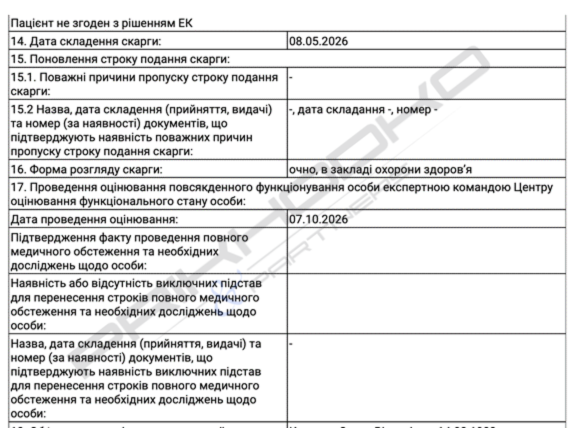
- Preparing and submitting a reasoned complaint: a complaint was submitted to the Centre for Assessment of Functional Status with references to the regulatory provisions of Resolution of the Cabinet of Ministers of Ukraine No. 1338; degree I limitation of daily functioning in relation to self-care, mobility and work was substantiated.
- Personal attendance of a lawyer at the in-person hearing: the lawyer personally accompanied the client at the meeting of the Centre’s expert team; the procedural presence of legal counsel prevented a superficial examination, ensured proper review of every medical document, prevented psychological pressure and ensured that all objections were recorded in the minutes.
Outcome of the review
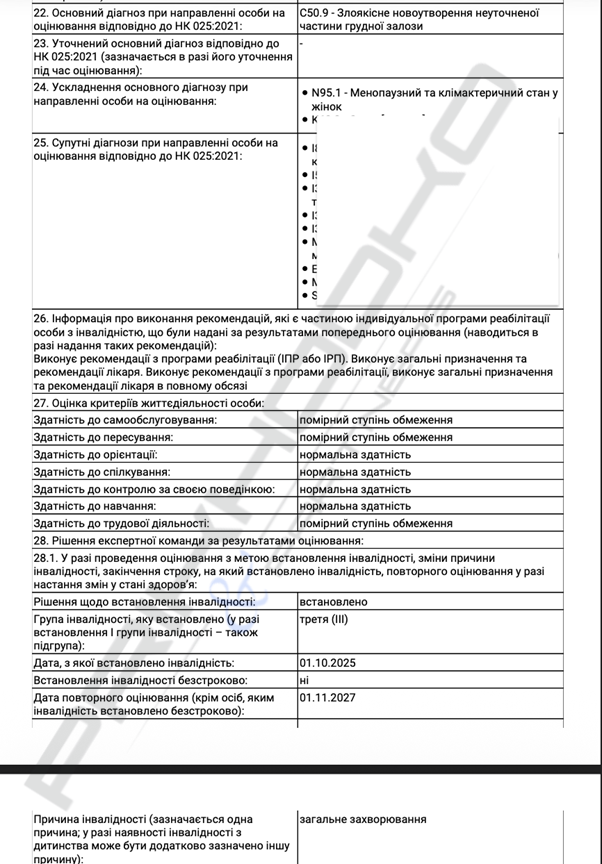
The Centre for Assessment of Functional Status expert team upheld the complaint in full:
- the previous unlawful refusal decision was cancelled;
- Group III disability status was established under the category of “general disease” for a period of 2 years;
- the right to social protection was restored retrospectively — the disability period was established from the date on which the previous status expired.
Benefits of involving a lawyer in the disability assessment process
Procedural control: the expert team operates within clearly defined regulatory limits when an authorised representative of the patient participates in the hearing. This prevents dismissive treatment and purely formal responses.
Legal assessment of medical status: the lawyer qualifies clinical symptoms under social protection legislation, focusing the experts’ attention specifically on the criteria that provide grounds for a disability group.
Protection of the right to rehabilitation aids: ensuring that all medically necessary devices and rehabilitation aids are included in the Individual Rehabilitation Programme.
Have you been refused the establishment or extension of disability status, or do you disagree with an Expert Team decision? The medical lawyers at Prikhodko & Partners will help analyse the documents, prepare a complaint and provide legal support during its consideration.
























































Юридичні послуги для медичного бізнесу та лікарів
 Telegram
 Viber
 WhatsApp


 Facebook
 Instagram