


Head of Medical Law Practice
Specializes in medical, corporate, and migration law. Has extensive experience working with medical and pharmaceutical businesses, particularly in licensing, circulation of medicines, and comprehensive legal support of healthcare institutions, including corporate, tax, and employment matters, as well as market entry projects of foreign companies into Ukraine.
Case: Obtaining Group III disability status for a servicemember after pneumonia and polyneuropathy

The reform of medical and social assessment fundamentally changed the rules in Ukraine: instead of the former MSEC commissions, assessments are now conducted by expert teams for the assessment of a person’s daily functioning under Resolution of the Cabinet of Ministers of Ukraine No. 1338.
The main difference of the new system is that the assessment considers not merely the diagnosis recorded in the medical file, but the actual functional deficit and limitations in the person’s daily functioning. Due to a lack of understanding of the updated criteria, patients may face refusals to issue an electronic referral, leaving them unable to undergo the appropriate assessment.
The medical law specialists at Prikhodko & Partners share a real case involving the protection of the rights of a servicemember who was refused referral for expert assessment after a severe complication of an illness.
The problem and the client’s initial circumstances
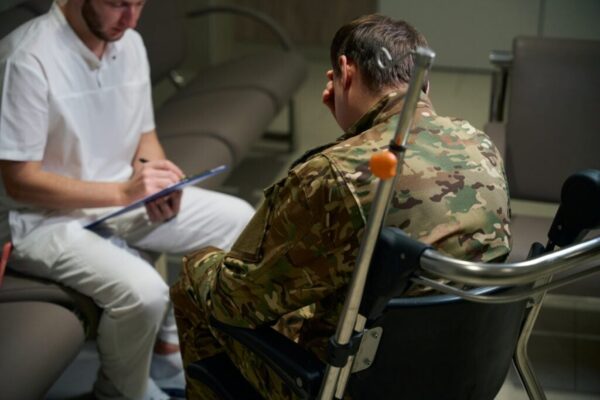
Client: an active servicemember of the Armed Forces of Ukraine.
Medical history: in January 2026, the client suffered severe hospital-acquired pneumonia, which resulted in a serious neurological complication — acute inflammatory polyneuropathy of the upper and lower limbs in the form of pronounced tetraparesis with impaired posture and gait.
Problem: the servicemember underwent a Military Medical Commission (MMC), but even after that the doctors refused to issue an electronic referral for an expert team assessment. The medical professionals’ reasoning amounted to formal delay: they claimed that “treatment dynamics are still ongoing” and that “there are insufficient grounds for referral”.
The servicemember faced a typical bureaucratic barrier: in practice, he was unable to move normally and had difficulties with self-care, but could not undergo the assessment procedure necessary to determine whether disability status should be established and to obtain the corresponding social protection.
Medical and legal audit: why was the referral refused?
When the client contacted our medical lawyer specialising in disability matters, we conducted an in-depth legal audit of the available medical documentation.
The analysis revealed a typical problem: the client’s discharge summaries contained only the clinical diagnosis (“polyneuropathy, tetraparesis”), while objective instrumental measurements and proper documentation of functional limitations relevant to the assessment of daily functioning were absent:
- Self-care — inability to perform fine motor tasks and dress independently because of weakness in the hands.
- Mobility — impaired coordination, instability, falls and inability to cover significant distances without a walking stick or crutches.
- Ability to work — having vocational training as a “painter”, the client completely lost the ability to perform work corresponding to his acquired qualification.
Without proper documentary evidence of functional impairments, it would have been more difficult for the expert team to objectively assess the degree of limitation in the client’s daily functioning.
Step-by-step procedure followed by the lawyers at Prikhodko & Partners
To convert the medical complaints into a proper evidentiary basis for the expert team, we developed an individual additional examination pathway for the client:
1. Referral to relevant specialists
The client was advised to undergo targeted examinations by three key specialists:
a neurologist — for an in-depth assessment of reflexes, sensitivity, electroneuromyography results and the severity of paresis;
an orthopaedic traumatologist — to assess joint mechanics and weight-bearing function, perform goniometry and assess muscle strength;
a physical and rehabilitation medicine doctor — to assess independence in everyday activities and the need for assistive mobility devices.
2. Clinical and instrumental documentation of impairments
All impairments were documented using precise measurements:
mobility function: significant difficulties in climbing stairs, boarding and leaving public transport, the need for assistance from another person and a medical recommendation to use additional support — a walking stick or crutches — were documented;
Romberg test: pronounced instability was recorded;
goniometry of the spine and limbs: limitations in the range of motion were measured in degrees using a goniometer;
manual muscle testing: limb muscle strength was assessed on a 5-point scale, confirming the presence of paresis.
3. Issuing an electronic referral for the expert team assessment
With the medical evidentiary basis prepared, our lawyers developed a legal position for the doctor. After the necessary examination results had been obtained, an electronic referral for assessment of daily functioning was issued with the medical documentation reflecting the existing functional impairments attached.
4. Lawyer’s presence during the expert team assessment
To monitor compliance with the procedure and properly present the client’s position, our medical lawyer personally accompanied the client during the expert team assessment. The lawyer drew attention to the goniometry measurements, the Romberg test results, functional limitations and the need for assistive rehabilitation devices.
Comparison table: before and after legal intervention
| Case parameter | Before contacting Prikhodko & Partners | After the lawyers prepared the evidentiary basis |
|---|---|---|
| Medical documentation | Only a discharge summary containing the diagnosis without proper documentation of the functional deficit | Comprehensive package: goniometry, Romberg test, muscle strength assessment, conclusions from a physical and rehabilitation medicine doctor and other specialists |
| Referral status | Doctors refused to issue a referral for the expert team assessment | An electronic referral for the assessment of daily functioning was issued |
| Assessment of daily functioning | Not properly reflected in the medical documentation | Limitations in mobility, self-care and the ability to perform professional activities were documented |
| Undergoing the assessment | Risk of undergoing the procedure without a properly prepared evidentiary basis | In-person assessment with legal support from a medical lawyer |
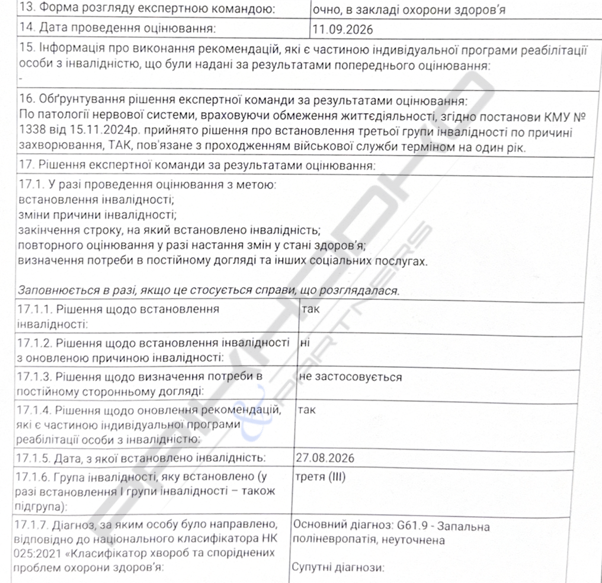
| Result | No disability group was established | Group III disability status was officially established, and the client exercised the right to payments and social guarantees provided by law |
Result for the client: Group III disability status established
Frequently asked questions (FAQ)
Are doctors required to refer a servicemember for an expert team assessment if the MMC has already been completed?
The fact that the MMC has been completed does not automatically constitute grounds for referral for an expert team assessment. The treating doctor issues the referral where the criteria for assessment of daily functioning are met and appropriate medical documentation is available. If referral is unjustifiably refused, it is advisable to conduct a medical and legal review of the documents and, where necessary, challenge the doctor’s actions or inaction.
Why is a diagnosis alone insufficient to establish a disability group in 2026?
Under Resolution of the Cabinet of Ministers of Ukraine No. 1338, the expert team assesses not only the diagnosis, but also the degree of impairment of bodily functions and limitations in the person’s daily functioning. The results of instrumental and functional examinations help objectively confirm the existing impairments and their severity.
What does having a lawyer present during the expert team assessment provide?
Legal support helps monitor compliance with the procedure, properly present the medical documents and circumstances of the case, and document possible procedural violations for subsequent appeal of the expert team’s decision.
Do you need assistance with obtaining disability status or undergoing an expert team assessment?
Do not spend months dealing with the bureaucratic system alone. If doctors refuse to issue a referral, you are unsure whether your medical documentation is complete, or you are preparing for an assessment, entrust your case to professionals.
Prikhodko & Partners provides comprehensive legal support:
- a detailed medical and legal audit of discharge summaries, other medical documents and MMC conclusions;
- recommendations on the additional examinations required to build a robust evidentiary basis;
- legal support with the issuance of an electronic referral for the expert team assessment;
- personal attendance by a lawyer to support the client during the expert team assessment.
Submit a request on the website or call us to receive an initial consultation with a medical lawyer regarding the establishment of disability status and the expert team assessment procedure.
















































Юридичні послуги для медичного бізнесу та лікарів
 Telegram
 Viber
Viber
 WhatsApp

 Facebook
 Instagram