


Head of Medical Law Practice
Specializes in medical, corporate, and migration law. Has extensive experience working with medical and pharmaceutical businesses, particularly in licensing, circulation of medicines, and comprehensive legal support of healthcare institutions, including corporate, tax, and employment matters, as well as market entry projects of foreign companies into Ukraine.
Case: Helped the client obtain Group III disability status due to visual impairment

Since 2025, decisions on establishing disability status have been made by Expert Teams for the Assessment of a Person’s Daily Functioning. The expert team assesses in detail not only the diagnosis, but also the patient’s actual functional impairment and limitations in daily activities.
Obtaining disability status for eye conditions is a process that requires accurate documentation of medical indicators. The client approached our medical lawyer with precisely this request.
The client contacted Prikhodko & Partners in order to:
- analyse the available medical documents and assess the prospects of obtaining a disability group;
- determine which disability group could be expected and which documents needed to be collected;
- receive turnkey legal support until a positive decision was issued by the expert team.
Medical criteria: how can visual impairment disability be confirmed?
To obtain a disability group, one of the following forms of visual impairment must be objectively confirmed by medical documents:
| Option 1: Blindness in one eye | Option 2: Reduced vision in both eyes |
|---|---|
| Corrected visual acuity of no more than 0.05 OR narrowing of the visual field in that eye to 10 degrees | Corrected visual acuity in the better-seeing eye of no more than 0.3 OR narrowing of the visual fields in both eyes to less than 40 degrees. |
Which documents must be included in the package for the expert team assessment?
A flawless evidence base should include:
- An extract or conclusion from an ophthalmologist.
- Visometry (measurement of visual acuity) — always performed during the consultation.
- Perimetry (measurement of visual fields).
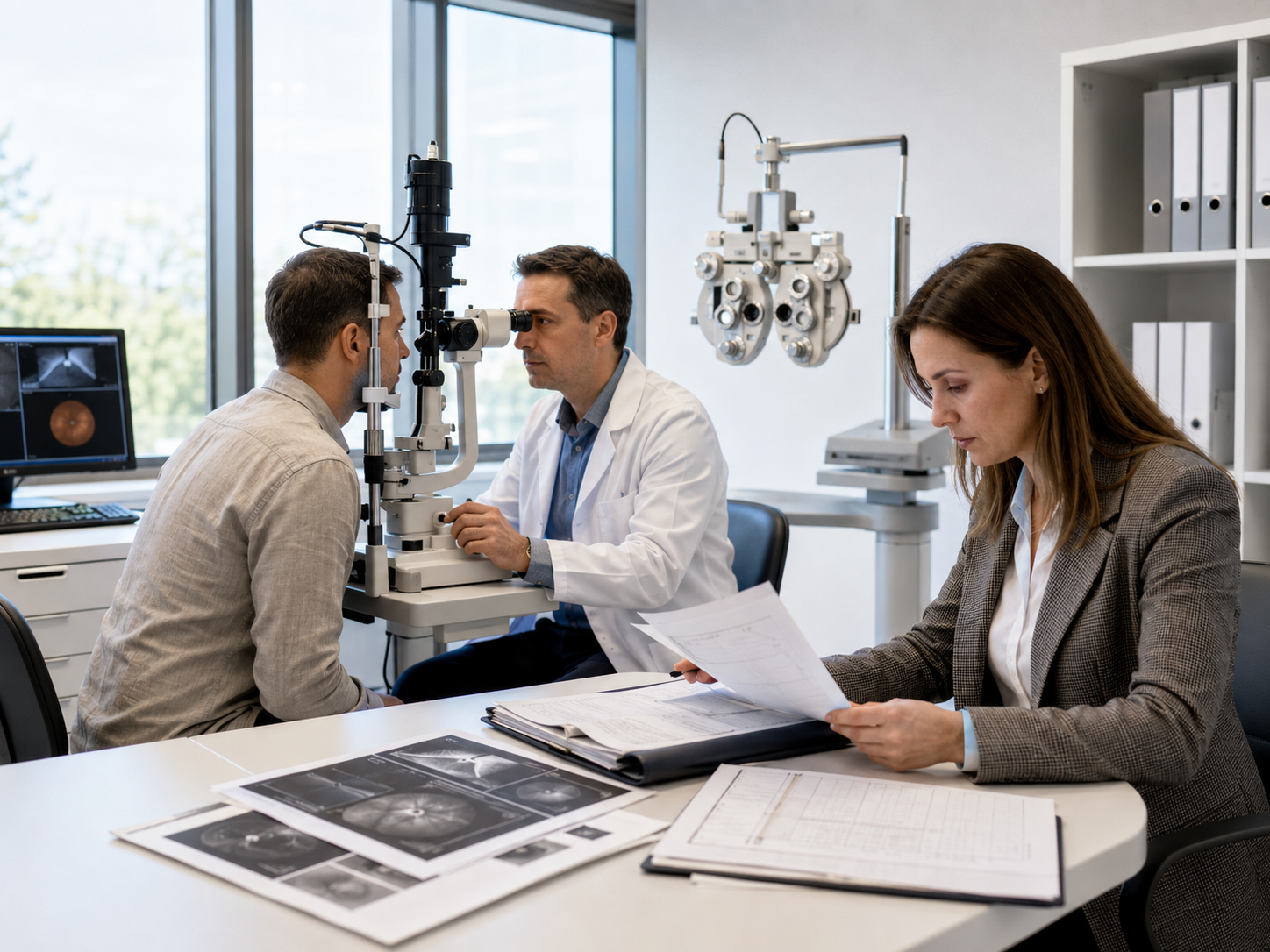
- Optical coherence tomography (OCT) or other supporting examinations (corneal topography, corneal biomicroscopy, evoked potentials, ultrasound, tonometry, etc.) — where required.
In our client’s case, the following were additionally required: autorefractometry, optical coherence tomography of the macula, biometry and examination of the anterior segment of the eye, as well as consultation reports from a neurologist and surgeon.

Turnkey work process and result
After analysing the documents, we recommended that the client have their vision reassessed at the current stage.
Our steps:
- arranged an appointment with a relevant specialist at a public clinic;
- helped prepare a complete and correct package of documents that conclusively confirmed limitations in daily functioning;
- helped correctly and promptly prepare the electronic referral to the expert team;
- provided in-person legal support by a lawyer during the review of the case.
Result: Thanks to professional legal support, the client was successfully granted Group III disability status.
Need help obtaining disability status?
Going through the expert team assessment independently often results in unjustified refusals caused by errors in the documents. Contact the market leaders — Prikhodko & Partners. We will provide comprehensive legal support, from auditing the medical records to obtaining a guaranteed decision!
Do you need to obtain disability status due to visual impairment or check whether your medical documents are sufficient for the expert team assessment? Submit a request — the medical lawyers at Prikhodko & Partners will audit the documents and provide legal support throughout the procedure.










































Юридичні послуги для медичного бізнесу та лікарів
 Telegram
 Viber
Viber
 WhatsApp

 Facebook
 Instagram