


Head of Medical Law Practice
Specializes in medical, corporate, and migration law. Has extensive experience working with medical and pharmaceutical businesses, particularly in licensing, circulation of medicines, and comprehensive legal support of healthcare institutions, including corporate, tax, and employment matters, as well as market entry projects of foreign companies into Ukraine.
Case: Helped a Client Obtain Group III Disability Status Due to Visual Impairment

A client with progressive loss of visual acuity approached the medical law practice of Prikhodko & Partners. Despite having a long history of the condition, the client faced several typical difficulties:
Uncertainty about the new rules: The reform of the MSEC system and transition to ADPF under Resolution of the Cabinet of Ministers of Ukraine No. 1338 changed the requirements for documenting functional impairments.
Uncertainty regarding the disability group: There was no clear understanding of whether the client’s current visual acuity and perimetry results met the criteria for Group II or Group III disability.
Risk of refusal due to deficiencies in documentation: The absence of specific instrumental examinations (OCT, corneal topography) in the initial medical record could have resulted in the referral being returned or the application being refused.
The client entered into an agreement for comprehensive turnkey legal support — from the initial audit to obtaining an extract containing the expert team’s decision.
Medical criteria for obtaining disability status due to visual impairment through ADPF (2026)
For a positive decision by an expert team in the field of “Ophthalmology”, the visual impairment must be objectively confirmed by clinical and instrumental data under one of the following scenarios:
| Category of impairment | Visual acuity criterion (with optimal correction) | Visual field narrowing criterion |
|---|---|---|
| Option 1 (Severe unilateral impairment / blindness in one eye) | 0.05 in one eye | 10° in the affected eye |
| Option 2 (Bilateral impairment) | 0.3 in the better-seeing eye | < 40° in both eyes |
Mandatory package of medical documents for ADPF
During preparation of the case, our medical lawyers compiled a complete list of documentation:
- A specialist opinion / discharge summary from an ophthalmologist at a municipal healthcare institution where the client had undergone periodic treatment.
- Visual acuity testing — official measurement of visual acuity (with and without correction)
- Perimetry — computerised or static measurement of visual fields.
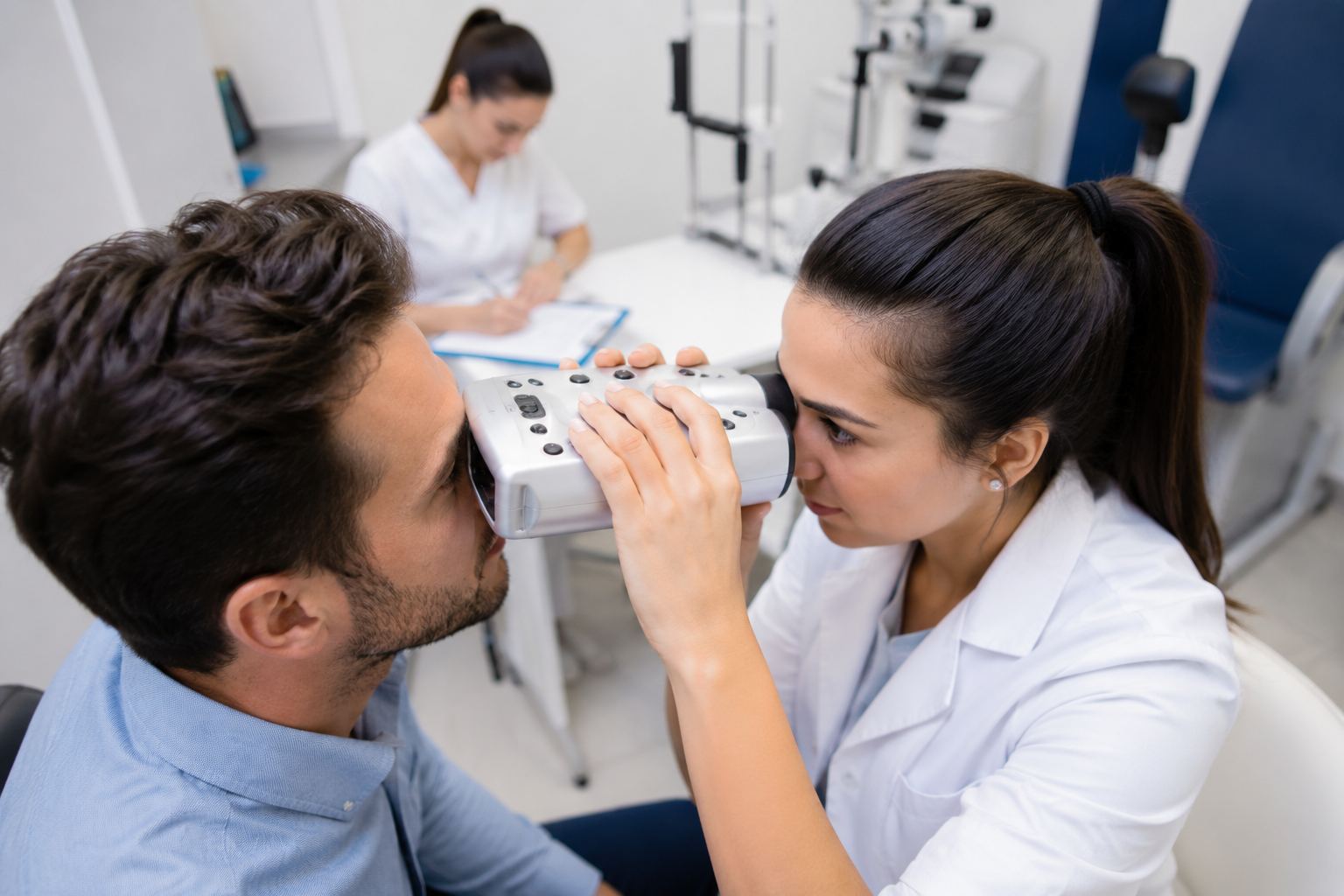
- Optical coherence tomography (OCT) and supporting examinations: corneal topography, biomicroscopy of the cornea and anterior segment, ultrasound examination (ultrasound / B-scan of the eye), tonometry (measurement of intraocular pressure), and assessment of binocular vision.
An important point: these examinations constitute significant evidence in the case because they provide details regarding the aetiology and pathogenesis of the condition (keratoconus, glaucoma, diabetic angiopathy, retinal dystrophy, etc.). However, the basic referral and primary specialist opinion must be issued by a doctor within the state/municipal healthcare system.
What our lawyers did: step-by-step process
- Medical and legal audit: the available medical record and previous discharge summaries were analysed. It was determined that the visual acuity parameters and structural corneal changes met the criteria for a moderate limitation of daily functioning (Group III).
- Organisation of additional examinations: a roadmap was prepared and the client was referred for high-precision corneal topography and OCT to document the stage of keratoconus.
- Examination at a state medical institution: a consultation with a specialist ophthalmologist at a state healthcare facility was arranged, with proper documentation of visual acuity testing.
- Preparation of the referral for ADPF: the accuracy of data entered into the electronic healthcare system (eHealth) and the referral was monitored, with emphasis placed on limitations relating to orientation and the ability to work.
- Legal support: full monitoring of the progress of the case before the expert team and participation of the lawyer during the commission’s consideration of the case until the decision was made.
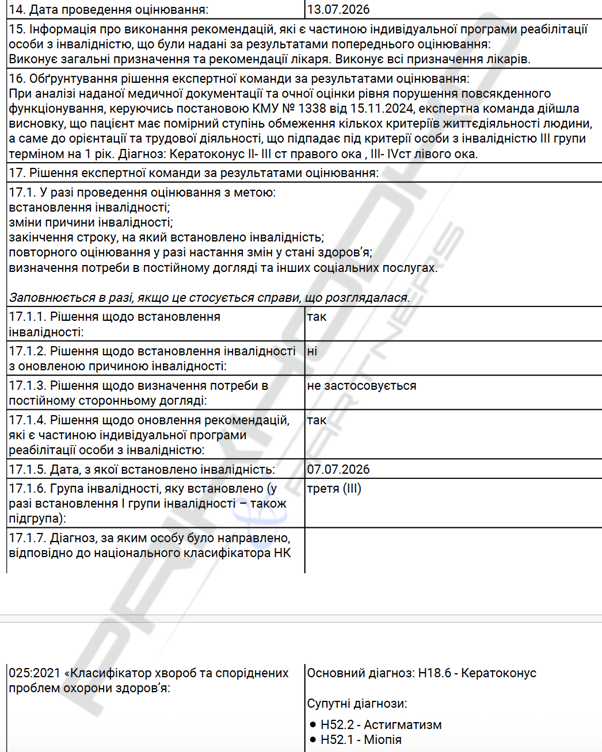
Following consideration of the case by the expert team (in accordance with Resolution of the Cabinet of Ministers of Ukraine No. 1338), the client was granted Group III disability status due to a moderate degree of limitation of daily functioning (orientation and ability to work).
Why entrust the disability status application process to experts?
Obtaining disability status through ADPF in 2026 requires impeccable medical substantiation. Incomplete information or the absence of a single instrumental test often becomes a reason for refusal.
We provide comprehensive support services:
- assessment of the prospects of obtaining Group I, II or III disability status.
- preparation of document packages for visual impairments, musculoskeletal disorders, diseases of internal organs, neurological conditions and others
- appeals against unlawful decisions or refusals by expert teams.
Frequently Asked Questions — Obtaining Disability Status Due to Visual Impairment through ADPF
Can Group III disability status be obtained for keratoconus?
Yes. In cases of progressive stage II–IV keratoconus, where corrected visual acuity in the better-seeing eye is 0.3 or lower or where there is significant visual field loss, the person has a legal right to be granted Group III disability status through ADPF.
Are reports and examinations from private ophthalmology clinics accepted?
Yes, instrumental examinations (OCT, computerised perimetry, corneal topography) from licensed private centres are accepted by the commission as evidence. However, it is recommended that the specialist ophthalmologist’s opinion and referral form in the eHealth system be issued by a doctor at a municipal or state institution.
What should I do if the ADPF expert team refuses to grant a disability group?
The decision of the expert team is subject to appeal through administrative or court procedures. Medical law lawyers analyse the meeting protocol, document procedural violations and submit a complaint to the assessment centre or file a claim with the administrative court.
Would you like to check whether your medical documents meet the disability criteria? Submit a request on the website for a consultation with a specialised lawyer.





















































Юридичні послуги для медичного бізнесу та лікарів
 Telegram
 Viber
Viber
 WhatsApp

 Facebook
 Instagram