


Head of Medical Law Practice
Specializes in medical, corporate, and migration law. Has extensive experience working with medical and pharmaceutical businesses, particularly in licensing, circulation of medicines, and comprehensive legal support of healthcare institutions, including corporate, tax, and employment matters, as well as market entry projects of foreign companies into Ukraine.
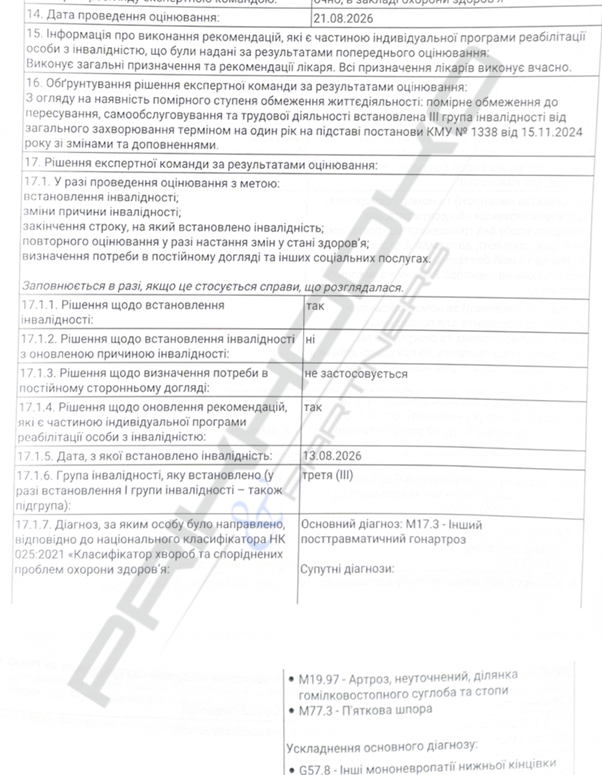
Case: Helped the client obtain Group III disability status after a severe injury

Obtaining disability status is a process that often turns into an exhausting marathon due to bureaucratic obstacles, indifference from doctors and unclear criteria for assessing a person’s health condition. In July 2026, a client from Lutsk contacted us after trying since 2024 to obtain disability status independently following a severe lower limb injury, but repeatedly facing refusals or being ignored by medical institutions.
In this article, we explain how a comprehensive approach, analysis of medical documents and professional legal support helped the client obtain Group III disability status in just one month.
Why are clients unable to obtain disability status on their own?
Our client’s situation is typical: family doctors refused to issue a referral for assessment, while specialised doctors were unwilling to work thoroughly with the medical documentation in order to formulate a well-substantiated clinical diagnosis.
Key problem: expert teams do not make decisions automatically based on “raw” examination results such as MRI or ENMG findings. They require not merely a diagnosis, but evidence of persistent impairment of statodynamic functions, properly documented in accordance with the requirements of Resolution No. 1338.
Clinical analysis and the lawyer’s strategy
Our team of medical lawyers, together with specialised professionals, conducted a detailed analysis of the client’s documents. A severe combination of pathologies affecting the left lower limb was identified:
Neuropathic and axonal deficit: ENMG findings confirmed persistent and severe post-traumatic damage to the peroneal nerve (a 70–72% reduction in amplitude) and tibial nerve (54–58%). This was the direct cause of impaired gait and foot drop.
Structural and joint deficit: MRI findings documented Grade III post-traumatic gonarthrosis, consequences of fractures (marks from the Ilizarov apparatus), a partial tear of the anterior cruciate ligament and a flap tear of the meniscus.
What we did to achieve the result
Correction of the clinical diagnosis: we helped the client consult specialised doctors so that the medical record in the electronic healthcare system (ЕСОЗ) reflected not only the symptoms but also their consequences: persistent impairment of posture and gait.
Proper documentation of findings: we ensured that objective goniometry (measurement of the range of motion in the joint) and a walking test were performed, as these are key for the expert team assessment.
Proving the persistence of the condition: we ensured that the electronic healthcare system reflected the ineffectiveness of conservative treatment over the preceding months.
Legal support during the assessment: our lawyer travelled to Lutsk to provide legal support directly during the expert team assessment.
Result: Group III disability status in one month
Thanks to a professionally prepared package of documents, in which every medical conclusion was supported by legally sound reasoning, the client obtained Group III disability status. The entire process, which had previously continued for years, took only one month with our support.
Why choose legal support from Prikhodko & Partners?
If doctors have refused to assist you or you cannot obtain a referral for assessment, do not waste time trying to fight the system on your own.
We offer:
- Legal analysis of medical documentation: assessment of the prospects of obtaining disability status before documents are submitted.
- Preparation of a robust package of documents: preparation of conclusions that the expert team cannot ignore.
- Legal support: full assistance throughout the expert team assessment process, including a lawyer attending the assessment in person.
- Appeal against unlawful decisions: if you have been refused without proper grounds.
Frequently asked questions about obtaining disability status after an injury
Is a diagnosis alone sufficient to obtain a disability group in 2026?
No. The new expert team assessment system evaluates not the mere presence of a disease, but the actual degree of impairment of bodily functions, including self-care, mobility and ability to work. A diagnosis is only the basis for commencing the assessment.
What should I do if my family doctor refuses to issue an electronic referral for the expert team assessment?
If the doctor refuses without justification, a medical lawyer should be engaged to conduct a legal audit of the medical documentation and remove bureaucratic obstacles through lawful procedures.
What is the advantage of having a lawyer present during the expert team assessment?
A lawyer ensures compliance with the procedure, helps prevent subjective understatement of functional limitation criteria and ensures that all medical evidence is taken into account by the expert team when making its decision.
Unable to obtain a referral for the expert team assessment, already received refusals or unsure whether your medical documents are sufficient to establish disability status? Contact the medical lawyers at Prikhodko & Partners for document analysis and comprehensive legal support.



























Юридичні послуги для медичного бізнесу та лікарів
 Telegram
 Viber
Viber
 WhatsApp

 Facebook
 Instagram