


Lawyer
Expert in international corporate, IT, and crypto law. Has extensive experience in business setup and support in the USA, EU, LATAM, and the Middle East. Specializes in corporate structuring, compliance, KYC/AML, IP, GDPR, as well as regulation of crypto and fintech projects.
Case: Built a business structure between Ukraine and the EU with separation of assets and operations

Service: international business structuring
Client: owner of a manufacturing and trading business
Jurisdictions: Ukraine, EU
Project period: Q4 2025
Background
The client approached us with a request to build a more secure and manageable business structure, within which it was necessary to separate asset ownership, operational activities, and the international contractual layer. In practice, this involved a model where one Ukrainian company would own real estate and infrastructure assets, a separate operating company would carry out manufacturing activities, and a European entity would be used for international procurement, contracting with foreign partners, and further expansion into EU markets.
Additional complexity
In this case, the situation was complicated by the following factors:
- the client did not want to concentrate real estate, equipment, contractual risks, and operational liabilities within a single legal entity;
- the structure had to be suitable not only for domestic operations in Ukraine but also for interaction with counterparties and service providers in the EU;
- a separate requirement was to ensure confidentiality of control and a clear logic of interaction between group companies;
- it was necessary to consider not only corporate structuring but also tax, contractual, and operational risks.
Actions of Prikhodko & Partners lawyers
- Initial legal analysis of the business model
We analyzed the client’s actual operations: who owns the assets, who bears the operational load, through which entities supply, procurement, leasing, cash flows, and interaction with foreign partners are carried out. We also determined which functions should remain in Ukraine and which should be moved to the European layer.
- Development of the corporate structure logic
We proposed a model separating assets and activities: a dedicated entity for owning real estate/infrastructure, a separate entity for operational activities, and an additional international element for cross-border operations. We assessed the advantages of this model in terms of risk reduction, clearer accounting logic, and scalability.
- Design of the contractual framework between entities
We defined which intra-group documents were required for the structure to function in practice: lease agreements, supply contracts, service agreements, intra-group support agreements, as well as documents governing asset use, liability allocation, and interaction between the Ukrainian and European parts of the business.
- Formation of a practical model for implementation
At the final stage, the client received not just general advice but a structured model of the future group: what functions each entity should perform, which contracts are required to launch the structure, and which risks should be considered in further implementation.
Result
As a result of the project:
- the client obtained a structured business model with clear separation of asset ownership, operational activities, and international functions;
- the risk of concentrating assets, liabilities, and contractual obligations within a single entity was reduced;
- a foundation was created for further corporate structuring in Ukraine and the EU;
- the client gained a practical understanding of how to organize interaction between group entities without overlapping functions.
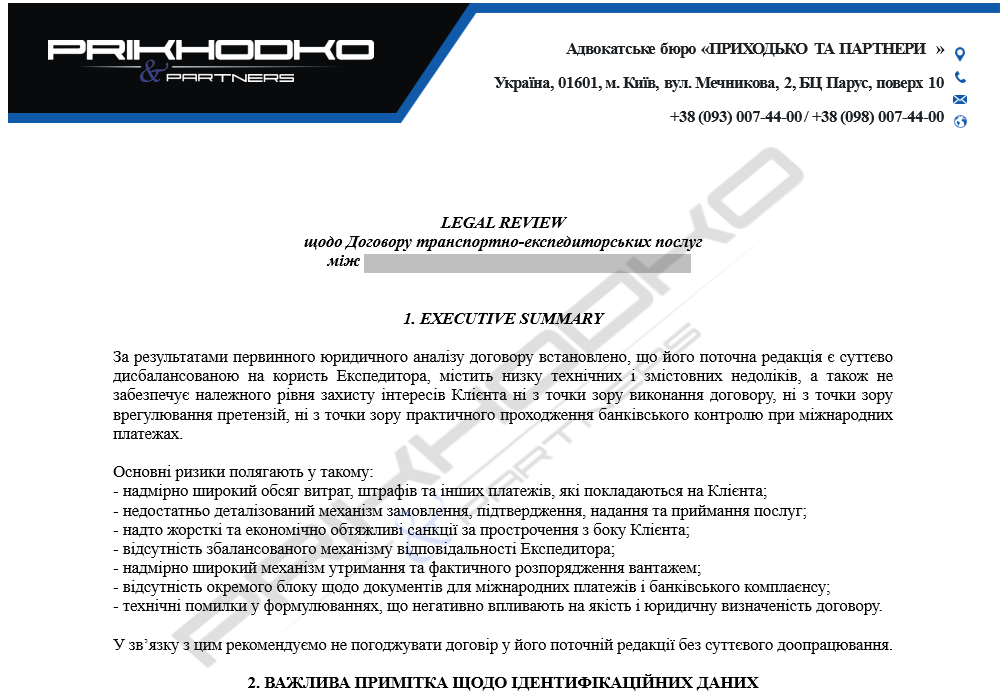
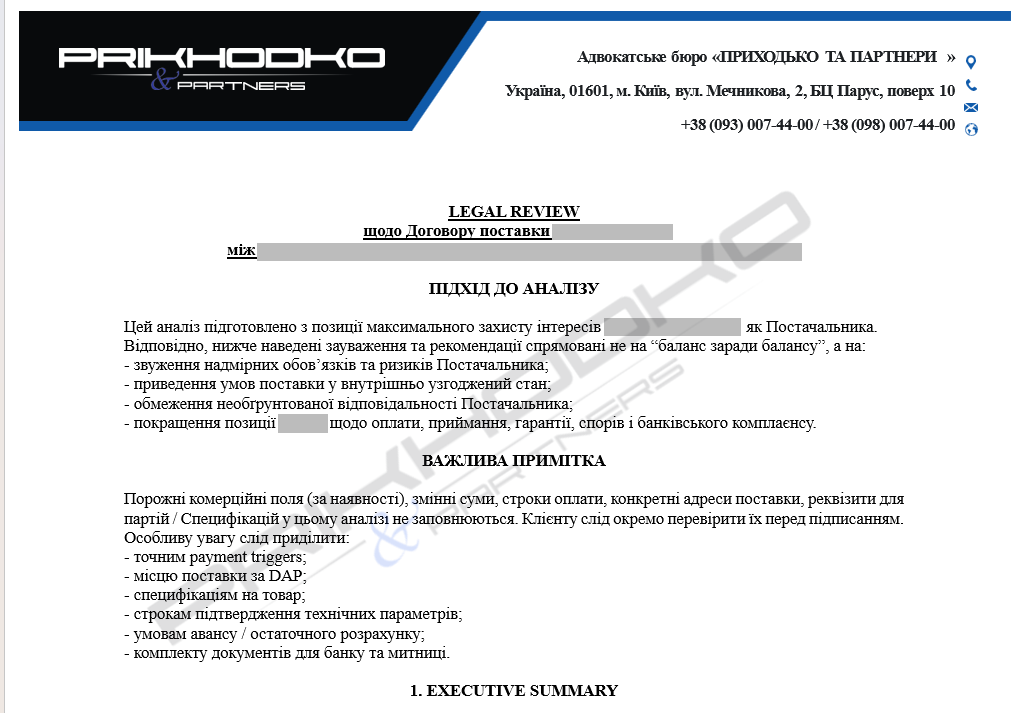
Below are excerpts from the contractual framework developed as part of this structure (redacted for confidentiality).
Key takeaways
- It is risky to build a manufacturing or trading business with an international component through a single “universal” company.
- Real estate, operational risks, and the international contractual layer should be separated at the planning stage.
- A European company should perform a real function within the business model, not serve as a formal add-on.
- Intra-group logic must be supported not only by a structure diagram but also by a full set of contracts.
How we can help
Prikhodko & Partners lawyers provide support in:
- business structuring in Ukraine and internationally;
- building group structures with separation of assets and operational functions;
- drafting intra-group agreements;
- analysis of tax and corporate risks in international business models.

























 Telegram
 Viber
Viber
 WhatsApp

 Facebook
 Instagram