


Lawyer
Expert in international corporate, IT, and crypto law. Has extensive experience in business setup and support in the USA, EU, LATAM, and the Middle East. Specializes in corporate structuring, compliance, KYC/AML, IP, GDPR, as well as regulation of crypto and fintech projects.
Case: Supported the Legal Analysis of a Humanitarian Project with a Multi-Million Budget

Client: international humanitarian consortium and Ukrainian partner organizations.
Jurisdictions: Ukraine; foreign donor and partner organizations.
Period of work: 2025–2026.
Grounds for request
The legal team was approached by the international humanitarian project “Remarket”, which was implemented with the participation of foreign donors, international organizations and Ukrainian partners. The project had a multi-year implementation horizon and a budget of several million Swiss francs.
The main task was to check whether the selected project implementation model could work correctly in Ukraine from the perspective of legislation on international technical assistance, tax rules, contractual structure, roles of participants and donor reporting requirements.
Separately, it was necessary not just to provide a general consultation, but to prepare a practical legal opinion that could be used as a working document for program management, building contracts, internal procedures and communication between participants.
Additional complication
- several foreign and Ukrainian organizations participated in the program at once, each of which had its own role, area of responsibility and expectations regarding reporting;
- the model provided for the use of donor funding, which required special attention to the targeted use of funds, documentary confirmation of expenses and the tax regime;
- it was necessary to distinguish the roles of the recipient, subrecipients, partners, executors, contractors and local program participants;
- there was a risk of incorrect application of benefits, improper drafting of contracts or erroneous determination of the status of operations;
- the legal model had to be understandable not only to lawyers, but also to operational teams, financial managers and project coordinators.
Actions of the lawyers of “Prikhodko and Partners”
1. Analysis of the actual project implementation model
We examined exactly how the program should operate in Ukraine: who receives funding, who performs activities, who is responsible for reporting, what documents accompany the movement of funds, goods or services and what roles Ukrainian and foreign participants perform.
2. Verification of international technical assistance status
The issue of registering the project as international technical assistance, the possibility of applying a special regime, requirements for project documentation and consequences for taxation of operations within the program were separately analyzed.
3. Tax analysis of operations
We assessed which operations may fall under special tax rules, what risks arise in case of incorrect documentary formalization and which documents must confirm the legitimacy of using benefits or exemptions.
4. Delimitation of the roles of program participants
It was separately analyzed what functions different project participants perform and how these roles should be reflected in contracts and internal documents. This made it possible to avoid a situation where the actual role of an organization does not coincide with the legal structure.
5. Analysis of contractual architecture
We provided recommendations on the structure of contracts between program participants, including provisions on the targeted use of funds, reporting, liability, confirmation of expenses, transfer of results and interaction with local partners.
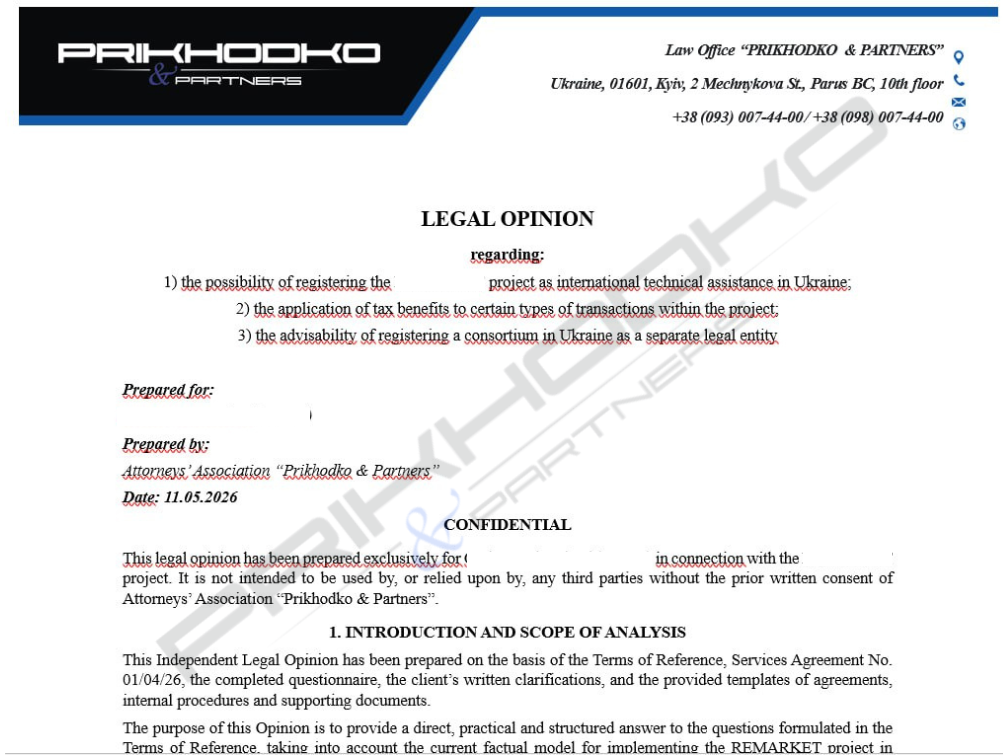
6. Preparation of a practical legal opinion
At the final stage, an extensive legal opinion was prepared with conclusions, risks and practical recommendations. The document was focused not on abstract theory, but on daily use during program implementation.
Result
- the project received a structured legal model for implementation in Ukraine;
- key legal, tax and contractual risks of the program were identified;
- participants received practical recommendations on drafting contracts, reporting and documentary support;
- an approach to delimiting roles between international and Ukrainian participants was formed;
- the legal opinion became a working basis for further program implementation, communication between the parties and minimization of risks before donors.
Practical conclusions
- An international humanitarian program requires not only a budget and good intentions, but also precise legal architecture.
- If the roles of program participants are not documented separately, this creates risks for reporting, taxes and liability.
- The international technical assistance regime and tax benefits work only when they are confirmed by proper documents.
- A legal opinion for a humanitarian project should be a practical risk management tool, not a formal annex to the grant folder.
- The larger the budget and the number of participants, the more important it is to agree in advance on the contractual model, reporting and financial logic of the program.
How we can help
- analyze the client’s situation and identify legally relevant risks;
- prepare the evidence base, documents and legal position for communication with counterparties, banks, platforms or donors;
- support negotiations, claim communication and further legal actions;
- build a legal model that works not only “on paper”, but also in the client’s real operational activity.
- legal support of international humanitarian and donor projects;
- analysis of the international technical assistance regime in Ukraine;
- preparation of legal opinion for donors, consortiums and Ukrainian partners;
- structuring of contracts between recipients, partners, subrecipients and contractors;
- tax analysis of operations within grant or humanitarian funding.
If you are implementing an international humanitarian or donor project in Ukraine, the lawyers of “Prikhodko and Partners” will help verify the legal model, structure contracts, prepare a legal opinion and minimize legal, tax and operational risks.





























 Telegram
 Viber
Viber
 WhatsApp


 Facebook
 Instagram