


Lawyer
Expert in international corporate, IT, and crypto law. Has extensive experience in business setup and support in the USA, EU, LATAM, and the Middle East. Specializes in corporate structuring, compliance, KYC/AML, IP, GDPR, as well as regulation of crypto and fintech projects.
Case: Development of a package of documents for a marketplace

Service: Development of a package of documents for a marketplace
Client: owner of an e-commerce platform / marketplace
Jurisdiction: Ukraine with a focus on online trade and remote customer service
Period of work: 2025–2026
Grounds for referral
The client requested the preparation of a complete package of legal documents for a marketplace operating under a platform model that hosts goods or offers from third parties. The main task was not just to draft formal texts for the website, but to establish a legal model that clearly defines the role of the marketplace, rules of operation for users and sellers, distribution of liability, procedures for processing personal data, and mechanisms for responding to claims.
Additional complication
In this case, the situation was further complicated by the fact that:
- the marketplace did not sell goods in its own name under a classic online store model, but instead acted as a platform / intermediary service;
- it was necessary to properly regulate relations with several categories of persons at once: users, sellers, and the platform administration;
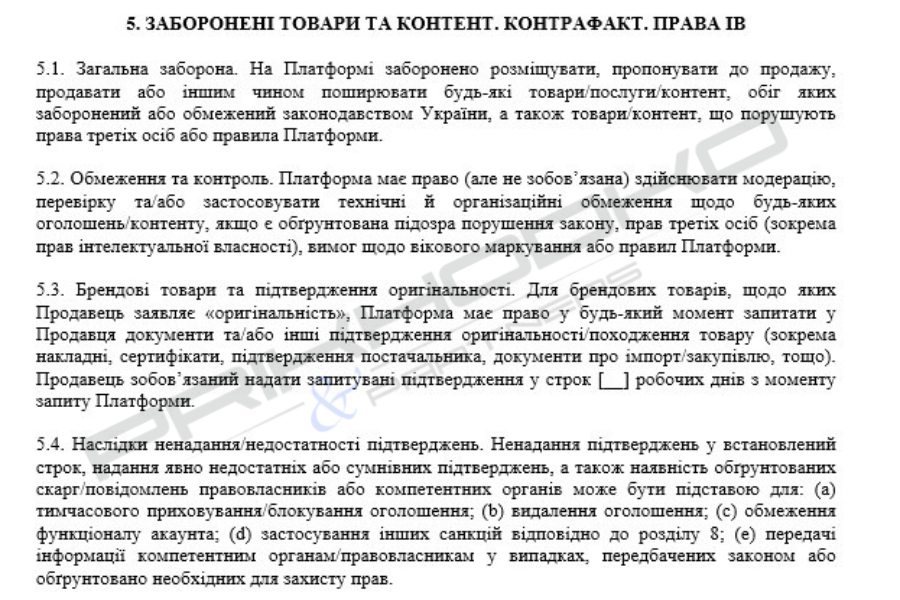
- separately, it was required to establish rules regarding content, intellectual property, complaints, account suspension, limitation of liability, and the platform’s role in transactions;
- the documents had to align with the client’s business model and be practical for day-to-day operational use.
Actions of “Prikhodko & Partners” lawyers
1. Analysis of the marketplace business model
We thoroughly analyzed how the platform operates: who lists the goods or offers, who enters into transactions with the end-user, how payments are processed, what functions the marketplace performs, and where the line is drawn between the role of the service and the role of the seller. This was critical for the correct legal engineering of all documentation.
2. Determining the composition and structure of the document package
Based on the analysis of the business model, a list of documents required for the platform’s operation was determined. Depending on the functionality of the marketplace, this involved preparing terms of use, public conditions / public offer, privacy policy, cookie policy, seller terms, return / complaint regulations, as well as auxiliary legal blocks to regulate the platform’s internal processes.
3. Development of a substantive legal framework for the documents
We did not limit ourselves to generic templates; instead, we addressed specific operational questions within the documents: the platform’s role as an intermediary, the procedure for listing goods and content, moderation rules, the right to restrict access to the service, the procedure for submitting and reviewing claims, fundamental provisions for personal data processing, the use of intellectual property items, and limitation of liability for the actions of sellers and users.
4. Aligning the package with the client’s practical needs
At the final stage, we compiled the package of documents into a cohesive legal framework for the marketplace, suitable not only for publication on the website but also for daily application in business operations. The client received documents that precisely reflected their specific business model, rather than an abstract e-commerce template.
Result
As a result of the work performed:
- the client received a comprehensive package of draft documents to launch or structure the operation of the marketplace;
- the platform’s role, rules for using the service, and the basic allocation of liability among participants were legally established;
- a foundation was formed for handling users, sellers, complaints, personal data, and content;
- the marketplace obtained a legal framework closely adapted to a real e-commerce model rather than a standard set of templates.

Practical conclusions
- For a marketplace, having just a “privacy policy and public offer” is not enough — a well-coordinated system of documents is required.
- If the platform’s role as an intermediary or service provider is not clearly specified, it creates additional liability risks.
- Legal documents must reflect the actual flow of payments, product listings, claims, and moderation, rather than serving as a formal decoration on the website.
- A package of documents for a marketplace must be engineered around a specific business model, not copied from someone else’s project.
How we can help
Lawyers at “Prikhodko & Partners” support:
- the development of documents for marketplaces, online platforms, and e-commerce projects;
- the preparation of terms of use, public offers, privacy policies, cookie policies, and seller terms;
- legal structuring of relations between the platform, sellers, and users;
- auditing existing website documents and adapting them to a real business model.









 Telegram
 Viber
Viber
 WhatsApp


 Facebook
 Instagram