



Senior lawyer
Expert in corporate and international corporate law. Has extensive experience in supporting the acquisition of financial licenses in Ukraine, as well as business incorporation in the EU, the United Kingdom, Switzerland, the UAE, and key Asian jurisdictions.
Case: Secured the Removal of Information About the Client’s Projects from a Publication on the Official NSSMC Website — Without Court Proceedings

A foreign company — an operator of online investment services registered in one of the EU countries — approached us. The official website of the National Securities and Stock Market Commission (hereinafter — the Commission, NSSMC) had published an informational and educational material on investment scams in which the client’s projects were included in a list of so-called “SCAM projects”. In particular, it was alleged that they were the result of rebranding previously known questionable services, were linked to a specific legal entity, and the material was accompanied by an infographic describing signs of unfair solicitation of investors’ funds.
A publication by a state regulator has a fundamentally different impact from a media post: market participants refer to it, search engines index it, and it is often cited in other jurisdictions. For a company operating in the financial sector, this creates direct operational risks — from additional questions by banks and payment providers to complications in negotiations with counterparties.
The task was clearly defined: to secure the removal from the publication of information that had no documentary confirmation — preferably without court proceedings and without public exposure that would only amplify the dissemination of the information itself.
Why we chose a pre-trial approach
The obvious option was to file a claim for protection of business reputation and retraction of false information. We deliberately did not start with litigation, for the following reasons:
- court proceedings against a public authority can last for years, while the disputed publication remains publicly available and continues to be indexed throughout that period;
- the very fact of filing a lawsuit is a public event that attracts additional attention to the material and works against the client;
- in reputation protection cases, the key issue is the defendant’s evidence base — and this can be tested before litigation by means of an attorney’s request;
- if the authority amends the material voluntarily, the client can achieve the result within months rather than years and without creating a public record of the dispute.
This determined our strategy: first document that the regulator had no supporting evidence, and only then demand removal of the information — relying on the regulator’s own written responses.
Challenges of the case
- Presumption that a public authority’s actions are substantiated. An official publication by a regulator is generally perceived as being based on verified information. This assumption can only be rebutted with documentary evidence, not arguments about unfairness.
- Educational format of the material. The publication was presented as informational and educational content rather than as an official decision, warning or individual administrative act. Such a document is difficult to challenge through standard procedures because formally there is nothing to annul.
- Absence of a specific procedure. The legislation does not provide a separate mechanism for removing or correcting a publication on the website of a public authority: there is no prescribed form of application, no statutory review period and no designated responsible official.
- Status of the foreign client. The non-resident company does not operate in Ukraine and is not an entity supervised by the Commission, meaning that formally it is not a party to any proceedings — it was therefore necessary to establish a procedural interest.
- Risk of formalistic responses. The most likely scenario in such cases is receiving replies “within the scope of competence” without any substantive action, while the publication remains unchanged for years.
What we did
The work was structured as a sequence of written submissions, with each subsequent step based on the result of the previous one:
- Conducted a legal analysis of the publication. We identified specific statements of fact that could be tested for accuracy and separated them from value judgments that are not subject to retraction. This list became the subject of all subsequent demands.
- Sent the first attorney’s request demanding the sources and documentary grounds for the statements concerning the client’s projects: results of the regulator’s own reviews, documents from law enforcement authorities, court decisions and internal analytical materials.
- Sent a repeated attorney’s request, specifying the questions that the regulator had failed to answer substantively. Taken together, the responses established the key point: the information had been taken from separate online publications — without independent verification, without obtaining explanations and without any supporting documents.
- Prepared a formal letter addressed to the Chairman of the Commission. In it, we systematised the responses received as evidence of the absence of a factual basis and substantiated the demand by reference to Article 32 of the Constitution of Ukraine, Articles 277, 280, 297 and 299 of the Civil Code of Ukraine, paragraph 6 of part one of Article 14 of the Law of Ukraine “On Access to Public Information”, and Article 10 of the Convention for the Protection of Human Rights and Fundamental Freedoms. We separately emphasised the heightened standard of care that the case law of the ECtHR imposes on public authorities when disseminating information capable of affecting reputation.
- Formulated the demand as an alternative: either provide evidence confirming the accuracy of the disseminated information or bring the publication into compliance with the law by removing or correcting the unverified information. This structure leaves no room for a non-substantive response.
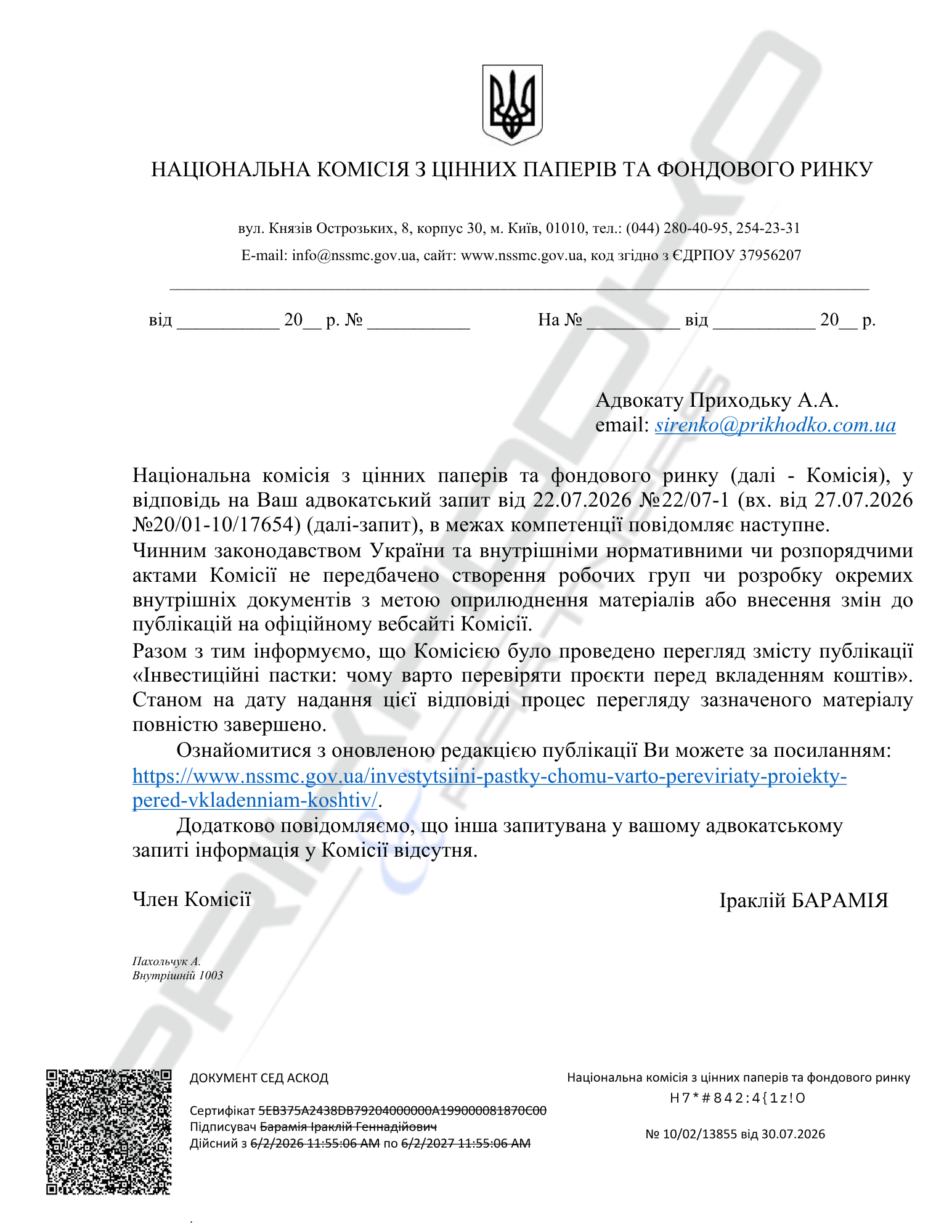
- After receiving written confirmation of a decision to review the publication, which contained neither a timeframe nor a procedure for conducting the review, we sent a third attorney’s request regarding the status and results of the review: the commencement date, legal basis, responsible structural unit, list of actions actually taken and expected completion date.
- Kept the correspondence within a strict legal framework. We recorded incoming reference numbers and deadlines, and in each request reminded the authority of the five-day response period under Article 24 of the Law of Ukraine “On the Bar and Practice of Law” and administrative liability under Article 212-3 of the Code of Ukraine on Administrative Offences for incomplete, late or inaccurate provision of information in response to an attorney’s request.
Result
The Commission reviewed the content of the publication and confirmed completion of the review in writing. The disputed information concerning the client’s projects was removed — the material remains available on the regulator’s website in an updated version.
The result was achieved at the pre-trial stage, without filing a lawsuit and without public exposure — approximately four months after the first attorney’s request. The client’s right to judicial protection remained fully preserved, but there was no need to exercise it.
A separate practical benefit was that the client retained written responses from the regulator documenting the absence of substantiated claims against it. This provides a practical argument in communications with banks, payment systems, auditors and potential partners — while also serving as a ready-made evidence base in the event of future disputes.
Why clients choose us
Reputation disputes with public authorities are almost never resolved by a single “strong letter”. What works is a sequence: an attorney’s request formulated so that the question cannot be avoided with a formal response; documenting every response as evidence; and only then presenting a demand built on the opponent’s own statements. An early mistake — an emotional complaint, a demand without a clearly defined subject, or a missed deadline — can close this route and leave litigation as the only option.
We handle such cases on a full-cycle basis: analysis of the disputed material and assessment of prospects, attorney’s requests, pre-trial submissions and, where necessary, court protection of business reputation and support with enforcement of the judgment. We work with foreign clients, including those with no presence in Ukraine.
Has false information about your company or project been published on a public authority’s website or in the media? Submit a request — we will assess the prospects of the case and prepare a step-by-step action plan.









 Telegram
 Viber
Viber
 WhatsApp

 Facebook
 Instagram