



Senior lawyer
Expert in corporate and international corporate law. Has extensive experience in supporting the acquisition of financial licenses in Ukraine, as well as business incorporation in the EU, the United Kingdom, Switzerland, the UAE, and key Asian jurisdictions.
Case: Legal Opinion on the Sale Value of an Operating Business

The owners of a full-cycle private educational institution in Kyiv approached us — a brand with more than 30 years of history, covering preschool, primary, middle and high school education, with its own site of approximately one hectare. The owners decided to sell the business and faced a problem typical of such transactions: they had an intuitive understanding of what the business was worth, but they did not have a document that could be presented to a buyer.
The situation was complicated by the transaction structure. Neither individual assets nor real estate were being sold. Instead, one hundred per cent of the shares in the company’s authorised capital were to be transferred — that is, the operating business together with the right to conduct educational activities, the brand, contractual base and established team. The real estate and land plot were excluded from the sale and were to be provided to the buyer under a separate long-term lease agreement on preferential terms. Therefore, almost the entire value was concentrated in intangible elements — and these are the most difficult to substantiate to a buyer.
The task was formulated as follows: to prepare a document that would simultaneously qualify the subject matter and structure of the transaction from a legal perspective and substantiate a specific valuation using recognised valuation approaches — so that it could withstand scrutiny by the buyer and its advisers.
Why a legal opinion rather than a valuation report
The first question we discussed with the client was what type of document was actually required. A formal property valuation report is prepared by a certified valuation entity and is mandatory in cases expressly defined by law. A sale of corporate rights by agreement between the parties is not one of them. We selected the format of a legal opinion with financial substantiation because:
- what works in negotiations is not a certificate but a transparent methodology — the buyer needs to see which indicators were used to derive the figure and be able to recalculate it;
- a traditional valuation report does not answer the legal questions of the transaction — what exactly is being sold, how the right to conduct educational activities transfers, and what happens to the lease and trademark;
- the buyer will conduct its own due diligence in any event, so the document had to identify potential issues in advance rather than conceal them and present them as ordinary matters requiring agreement in transactions of this type;
- the legal opinion format makes it possible to combine legal qualification, calculations and an open financial model in one package.
The key decision was that from the outset the document was drafted not for the owners, but for the buyer — as a document with which negotiations could begin rather than an internal memo “for our own use”.
Challenges of the case
- Value concentrated in intangible elements. The brand, student base and contracts with families, educational programmes and teaching team do not have a balance-sheet value, yet they form the main part of the purchase price. Such value can only be substantiated through profitability rather than assets.
- Gap between tax and management reporting. The official financial statements of a small enterprise do not reflect its actual operating profitability. It was necessary to reconcile both reporting streams and normalise the result so that it was verifiable rather than “manufactured”.
- The 2022 anomaly. The drop in revenue at the beginning of the full-scale war, when viewed over a five-year period, appears to indicate business instability. Without an explanation, the buyer interprets the chart against the seller.
- Lease as a value factor. The business operates from premises that are not included in the sale. Preferential lease terms significantly reduce the buyer’s operating costs and therefore directly affect the price, while also creating dependence on the continuation of those terms. This could neither be omitted nor presented as an unconditional advantage.
- Regulatory dimension of educational activities. The institution operates in a sector subject to licensing indicators and mandatory registration in the register of educational activity providers. A change of owner requires the relevant information to be updated — and the buyer needs to understand this procedure before signing.
- Absence of an open market of comparable transactions. Private schools in Ukraine are rarely sold, and there is no publicly available data on transaction multiples. The selected multiple therefore had to be substantiated by the characteristics of the business itself rather than by reference to “market data”.
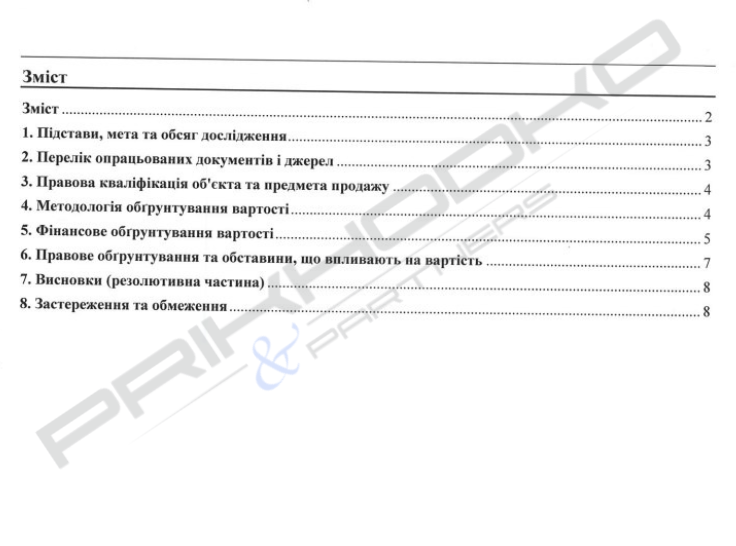
What we did
We structured the work along two parallel tracks — legal and financial — which were brought together in the concluding section:
- Qualified the subject matter and structure of the sale. We established that corporate rights, rather than individual assets, were being transferred and that the business had to be valued on a going concern basis. This determined the methodology used at all subsequent stages.
- Collected and analysed the evidence base. Financial statements for five years and the current quarter, trial balances, management accounts, staffing schedules and remuneration rates, pricing for educational services, student numbers, revenue breakdown by business area, an owners’ questionnaire covering corporate, regulatory and property matters, and information from public registers.
- Normalised the profitability indicator. We calculated EBITDA adjusted for one-off and non-operating items — a core metric understandable to any buyer and its financial adviser.
- Broke down revenue by business segment — preschool, primary, middle and high school education, and additional services — over a two-year period. This shows the buyer not only the scale of revenue, but also its diversification and sources of growth.
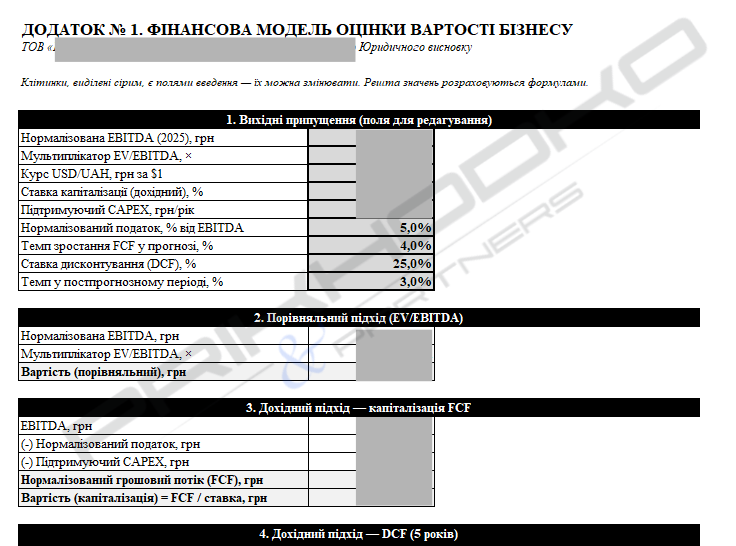
- Applied two independent approaches. A market approach based on an EV/EBITDA multiple and an income approach based on capitalisation of normalised cash flow and discounted cash flows over a five-year horizon. The results were reconciled using weighting coefficients rather than simply selecting the most favourable figure.
- Presented the calculation as an open financial model. The appendix to the legal opinion is not a static table but a working file with input fields for the multiple, capitalisation and discount rates, maintenance CAPEX, growth rates and exchange rate. The buyer can input its own assumptions and see the resulting valuation — eliminating suspicion that the figure was “reverse-engineered”.
- Built a sensitivity table. A valuation matrix based on different EBITDA values and multiples shifts the negotiation from “why exactly this amount?” to “within what range are we negotiating?” — which is a more favourable discussion for the seller.
- Substantiated premium factors in a separate section: a brand with more than 30 years of history and market recognition, a premium location with full infrastructure and a shelter, a full-cycle education model ensuring long-term relationships with families, a preferential long-term lease agreement, an established teaching team and proven educational programmes.
- Conducted a legal audit of circumstances affecting the transaction and presented them in a table: the lease agreement, rights to the trademark, domain and educational materials, updating information in the register of educational activity providers, the procedure for transferring management and retaining key personnel during the transition period, asset inventory, absence of encumbrances over the shares and proper contribution of the authorised capital.
- Defined the qualifications and limitations of the document. The legal status of the opinion, data sources, the conditional nature of the valuation based on continuity of operations and continuation of the preferential lease, the procedure for recalculating the foreign currency equivalent as of the transaction date, and confidentiality provisions. This is not a formality: properly defined limitations are precisely what prevent the document from being used against its author.
Result
The client received a complete package: a legal opinion containing a concluding section and a financial model forming an integral appendix to it. The opinion fixed a specific substantiated sale value of the business — in Ukrainian hryvnia and its US dollar equivalent at a defined exchange rate, together with an explanation of how the amount should be updated.
In practical terms, this gave the owners three things. First, a negotiating position: the price was no longer merely the seller’s expectation but the result of a methodology that the buyer could independently verify. Second, a manageable range: the sensitivity table defines in advance the boundaries within which the seller is prepared to negotiate and prevents the buyer from pushing the price down without justification. Third, control over the due diligence agenda: lease arrangements, intellectual property, regulatory procedures and transfer of management were disclosed by the seller in the document itself as ordinary matters for transactions of this type rather than discoveries made by the buyer, each of which could otherwise become a reason to demand a discount.
Why clients choose us
A business sale is a point at which law and finance cannot be separated. A valuer provides a figure but does not answer what exactly is being sold or how the right to conduct the activity transfers. A lawyer describes the transaction structure but does not substantiate the value. A buyer immediately sees the gap between these documents — and uses it to negotiate the price down.
We prepare such opinions on a full-cycle basis: legal qualification of the subject matter and transaction structure, normalisation of financial indicators and model development, substantiation of the multiple and sensitivity analysis, identification of circumstances affecting the price, followed by negotiation support, preparation of transaction documentation and closing of the transaction.
Planning to sell a business, attract an investor or bring a partner into the company’s capital? Submit a request — we will assess the transaction structure and prepare a substantiated valuation that can be presented to a buyer.









 Telegram
 Viber
Viber
 WhatsApp


 Facebook
 Instagram