


Attorney
Specializes in family law and inheritance matters.

HOW TO RECOGNIZE IMMOVABLE PROPERTY ACQUIRED IN MARRIAGE, PERSONAL PRIVATE PROPERTY OF ONE OF THE SPOUSES?
Table of Contents:
In Ukrainian family law, the "presumption of community property" applies. This means that by default, any apartment, house, or land plot acquired during the marriage belongs equally to the husband and wife (50/50), regardless of whose name it is registered under.
However, life dictates its own scenarios, and often the need arises to prove that a real estate object is the personal property of one of the partners.
Lawyers of Law office "Prykhodko and Partners" have significant experience in resolving property disputes and will help you understand how to legally "remove" property from common status.
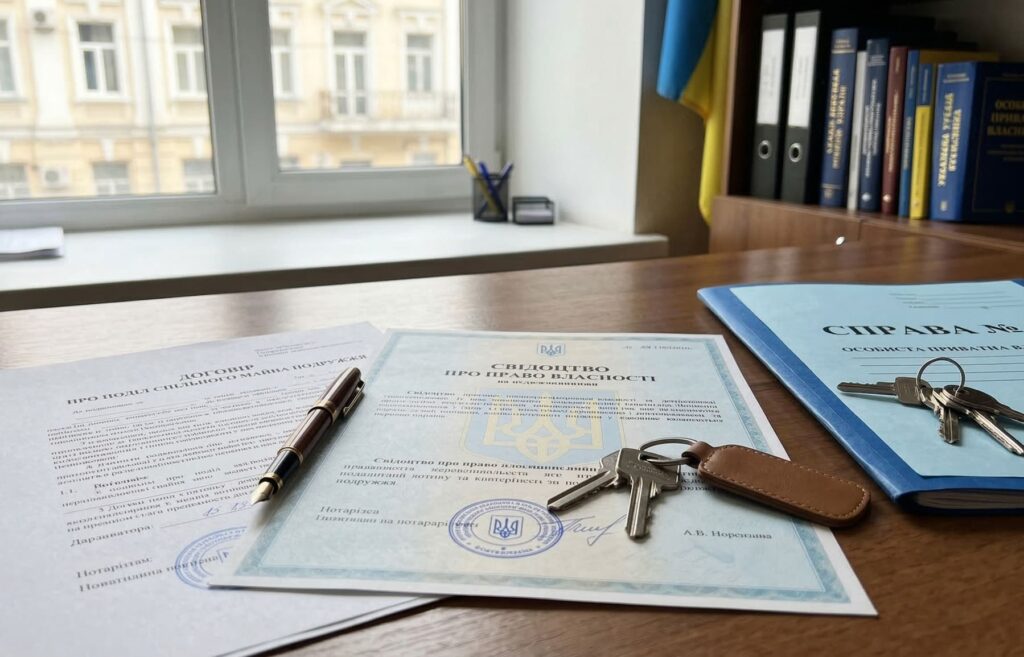
Legislative Foundation: Article 57 of the Family Code of Ukraine
Article 57 of the Family Code of Ukraine clearly defines the list of circumstances under which property acquired after the wedding is considered the personal private property of the husband or wife:
- Inheritance and Donation: If the real estate was received as an inheritance or under a donation agreement.
- Acquisition with Funds Belonging to the Person Before Marriage: This is the most widespread, but also the most difficult category to prove.
- Privatization: Property received through the privatization of a land plot or state housing stock (taking into account changes in legislation regarding privatization periods).
- Acquisition of Property Before Marriage Registration.
The most frequent request to our lawyers: "I sold an apartment I owned before the marriage and immediately bought a new one while already married. How do I prove it is only mine?".
The Supreme Court, in its rulings, emphasizes: the key factor is the source of funds. For the court, the fact of having money before the marriage is not enough.
It is necessary to prove:
- The existence of personal funds (income certificate, agreement for the sale of previous property).
- The use of precisely these funds for the purchase of new real estate (bank statements, coincidence of dates and amounts).
If even a small amount from the joint family budget was added to the purchase of a new apartment (for example, for renovation or an additional payment for area), the court may recognize the property as joint, but with the definition of shares according to each partner's contribution.
Separate Residence and Termination of Joint Household
In 2026, courts began to examine cases concerning property acquired in a "formal marriage" more scrupulously.
If the spouses have actually separated but have not filed an application with the Civil Registry Office or the court, the property acquired during this period is still considered joint by the general rule.
To recognize it as personal, a lawyer must prove:
- Absence of a joint household and budget.
- Fact of living at different addresses (lease agreements, witness testimonies, separate utility payment receipts).
- Absence of intent to create a family at the time of purchase.
Procedural Aspects: How to Exercise the Right?
There are two main ways to secure the status of personal property:
Out-of-Court Route (Notarial)
The spouses can enter into a Property Division Agreement or a Marital Agreement (Contract). The document can clearly stipulate that a specific apartment is the personal private property of one of them.
This is the fastest and most civilized method offered by the specialists of our bureau for preserving the clients' nerves and funds.
Court Route
If there is no agreement, a lawsuit is filed for Recognition of the Right to Personal Private Property.
Important: Courts in such cases require an impeccable evidentiary base. Any inaccuracy in documents or the absence of primary financial papers may lead to the rejection of the claim.
Risks and "Pitfalls"
Many mistakenly believe that if the property is registered in the name of one spouse in the State Register of Real Rights, it is already personal. This is a myth.
A notary always requires the consent of the second spouse when formalizing a purchase and sale. The existence of such consent is another argument in favor of the "community" of the property in a future court.
It is also worth remembering Article 62 of the Family Code of Ukraine: if the property of one of the spouses has significantly increased in value during the marriage as a result of joint labor or monetary expenditures (capital repairs, reconstruction), it may be recognized by the court as joint community property.
Why should you contact Law office "Prikhodko and Partners"?
Real estate disputes require not only knowledge of the law but also an understanding of the "internal workings" of court proceedings and financial investigation skills.
Our advantages:
- Deep Analytics: We conduct a thorough audit of the origin of your funds and assess the realistic chances in court.
- Evidence Collection: Our lawyers help to obtain archival statements, bank confirmations, and other documents that are difficult to obtain independently.
- Professional Representation: We defend your property in courts of all instances, including the Supreme Court.
- Preventive Measures: We help to correctly formalize the purchase of real estate even at the stage of signing the agreement to avoid problems in the future.
Your real estate is your asset and your confidence in the future. Do not let legal inaccuracies deprive you of what rightfully belongs to you.
Calculate the price of assistance:
1 question
Have other lawyers handled your case?
2 question
Are you in Kyiv or Kyiv region?
3 question
Do you need legal assistance urgently?

call back
during the day

 Telegram
 Viber
Viber
 WhatsApp

 Facebook
 Instagram